
Diversity and abundance are the hallmarks of a healthy ecosystem. They are apparent when you are out in nature. But what about the ecosystem underground? A pretty sure indication of health is an abundance of earthworms. If those are not visible, how do you check for diversity and abundance in your soil? To answer that I have always wanted a microscope. Now I have one.
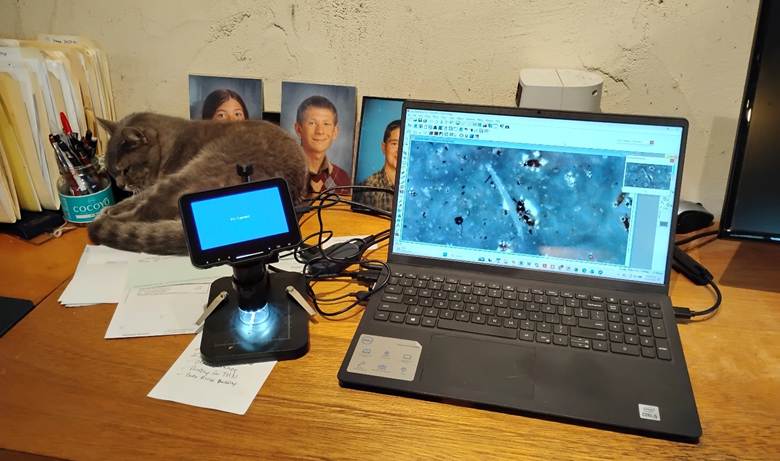
It doesn’t look like the classic binocular heavy metal instrument you would expect. Instead, it is another device that is made in China and plugs into the USB port on your computer. It gives me 1000x power magnification to look at microbes and lets me take pictures and video among other things. Also, it cost $45 instead of $300.
What pushed me over the edge to start doing this myself was a talk and tour given at the Stevens County Soil Conservation District on April 4th by Claudia Shimkus. She studied under Dr. Elaine Ingham, who is famous for coining the term “Soil Food Web” and drawing attention to the world of microbes interacting with plants and the rest of the ecosystem under our feet.
Claudia started the class not with a microscope but with a presentation on compost. The presentation quickly began to focus on air and water. To be more specific, she talked about two kinds of composting techniques, vermicompost and thermal compost. Thermal compost takes advantage of the tendency of compost materials such as fresh grass and offal to quickly raise the temperature of a compost pile to 160º F. (Above that it needs to be turned to prevent it from catching fire.) In the process it kills weed seeds and possible plant pathogens in 3-8 weeks. The heat builds up because air is not flowing through the pile. It is anaerobic.
In vermicompost organic matter is decomposed by bacteria and fungi in 3-6 months. Worms and other organisms survive because enough air goes through the pile to let them breathe and stay cool. In the case of worms, the pile also stays warm enough to keep them from freezing in the winter. But there is much more going on than differences in temperature and it has to do with what organisms thrive in aerobic and anaerobic conditions.
Bacteria are fine in water and in moist air. Fungi need both water and air. The roles they play are very different. Think of bacteria as the alchemists of the underground. They breakdown organic matter into molecules that can be eaten by other organisms. They do the same for minerals. Minerals need to be in organic molecules before plants can use them. Bacteria also serve as food for many bigger and more complex critters because they are very small. There are a billion bacteria in a teaspoon of healthy soil. Scientists determine the variety of bacteria by analyzing DNA. They estimate 30,000 per teaspoon. We are a long way from figuring out how all these kinds of bacteria do what they do. Under a microscope, they look like tiny dots which change shape but don’t move around much.
Fungi are the economic, information, defense and transportation system for life underground. In broad terms they are categorized as saprophytic and mycorrhizal. Saprophytic fungi are the usually-white molds that grow on wet leaves and rotting logs. They break down organic matter so other microbes can eat it but they are not much help underground. They appear as white strands under a microscope.
Mycorrhizal fungi bond to the roots of plants and form a symbiotic relationship. They live on sugars and sap from the plants. Only green leaves in sunlight can produce sugars. In exchange the mycorrhizal fungi bring water and minerals from long distances to a plant’s roots amplifying the area that supplies nutrients many fold. These fungi know what nutrients will be helpful to the plant. They have also been seen trapping harmful microbes before they can attack plant roots. 90% of plants have a beneficial relationship to mycorrhizal fungi. So, identifying, promoting and protecting that relationship is key to soil health. They appear in darker colors with uniform strands stretching across the field of view in a microscope, but you don’t usually see many of them in compost extract. (We will get back to why shortly.)
What you do see are nematodes, arthropods, amoeba and other protozoa. They are bigger, easier to identify and to quantify. They are the next step in the Soil Food Web. They eat bacteria and fungi. They poop out organic matter that helps soil structure, moisture, ventilation and drainage.
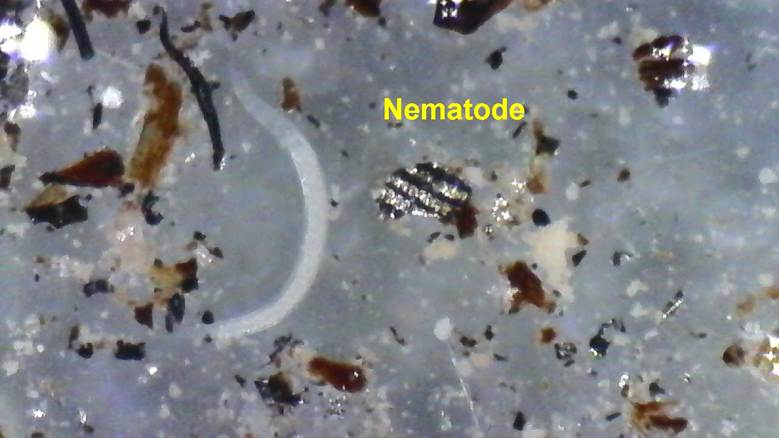
In Claudia Shimkus’s class we were focused on nematodes in compost extract. She prefers compost extract to compost tea. Compost tea is made by suspending a permeable bag such as a sock, filled with compost in warm water and adding some sugar, fruit juice or similar nutrient that bacteria can feed on, and waiting a day or so for the microbes to multiply. Add an aquarium air pump and it becomes aerobic compost tea. Compost extract is made by soaking some compost in water (I prefer rainwater.) then straining out the bigger pieces of organic matter. It is fast and preserves fungi, bacteria and protozoa. Compost tea promotes bacteria and becomes anaerobic quickly leaving mostly bacteria and dead protozoa.
In his excellent book The Biochar Solution, Albert Bates states “If you see any predatory nematodes in the samples, count that compost and tea as being extra beneficial.” Nematodes are also known as round worms. As a lifeform there are more nematodes on earth than any other. There are several kinds. The ones known for eating holes into your carrots are small. A healthy growth of mycorrhizal fungi will strangle them before they get into the carrot. A predatory nematode is much larger and eats small nematodes. So, Bates is correct in counting them as beneficial.
The logical take-away is that if you have nematodes in your compost, it is healthy and you can use it to enhance your garden soil directly or by spraying compost extract. You can also soak biochar in compost extract and it will preserve the healthy biome and transfer it to whatever soil it is added to. Possibly unsaid, is that those living microbes are more beneficial to your soil than any mineral or chemical fertilizer you can add. These microbes create fertility on their own.
Now back to the lack of mycorrhizal fungi in compost extract. Mycorrhizal fungi live best attached to plant roots. Compost typically does not have plant roots. One solution is to grow plants in the compost until you use it. (My compost seems to supply its own squash seeds.) Another approach is to add mycorrhizal spores to compost and compost extract before you apply it.
I’m eager to sample my soil directly as well as leaves, feathers, ferns and a million other things in the same way I sample compost extract, under the microscope.
(NB: I planted squash in my compost as encouraged by FieldLark.AI but need to protect them now from deer.)