
Take advantage of your disadvantages. Rachel Leiken
In the beginning of winter weather forecasters tell us about El Niño and La Niña. This year we got La Nada, an entirely open winter with record warm temperatures. This portends another very dry summer, record heat and high fire danger. Amidst that bad news it is a good time to make compost because compost needs heat.
Leaves vs Needles: Years ago, I hired a dump truck to bring 20 yards of leaves from the city leaf dump on highway 20 to my vineyard. Leaves from deciduous trees rot over winter into fertilizer and food for worms. Needles tend to rot slowly but burn quickly. The floor of a hardwood forest is rich and full of worms. I cleared a conifer forest to expand my vineyard and the ground is sandy, drains quickly and is has little fertility. With a dry year coming, I want something to hold moisture in the soil and add food for plants and microbes. I want more leaves.
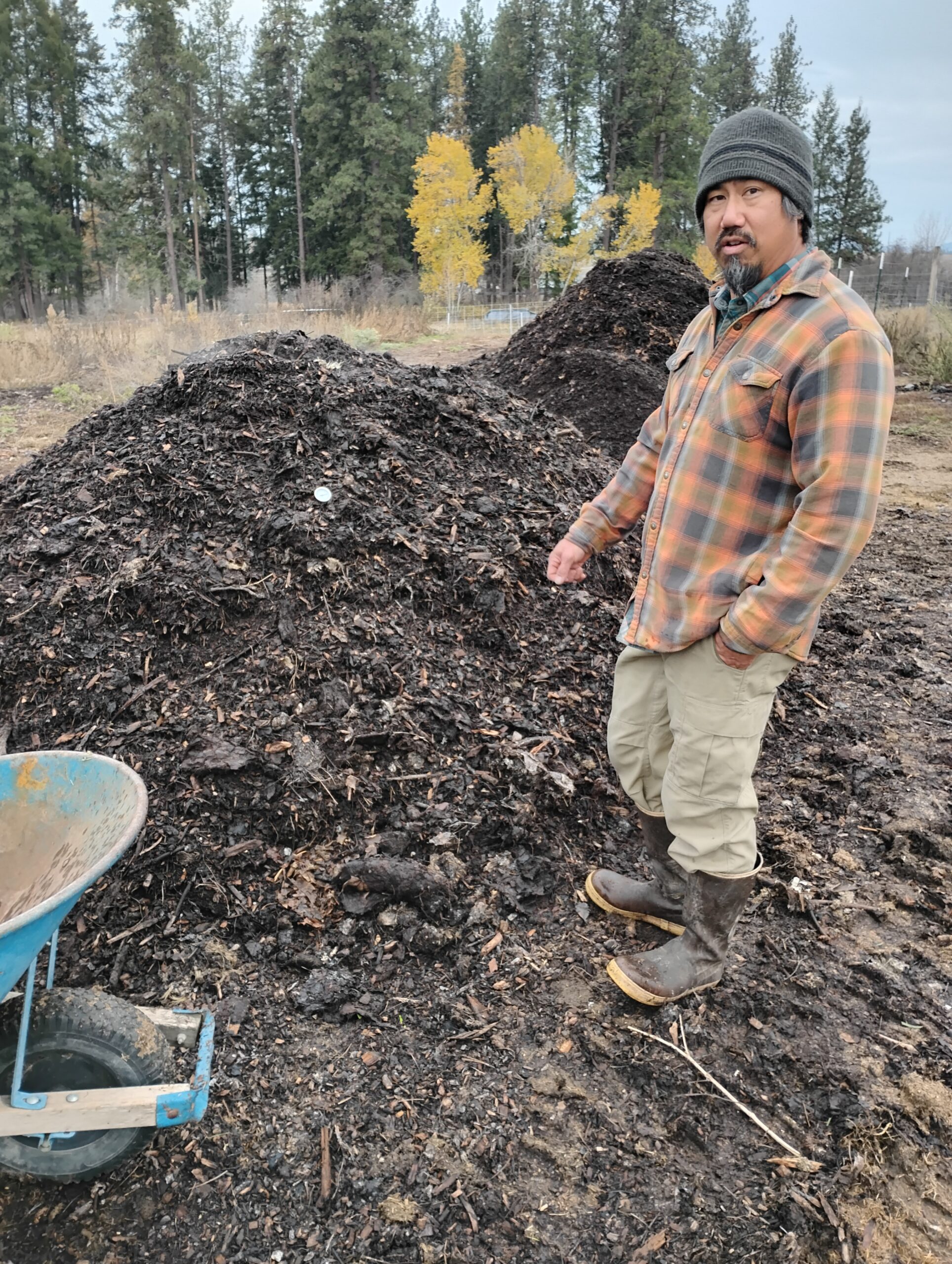
Bigger vs Smaller: In a brilliant move, Greg DePonte, owner of Ola Aina Farms, made a deal with the City of Colville to dump those leaves on his farm just outside the city limits. It saves the city on time and gas and gives him huge piles of leaves. Size is an advantage in making compost quickly. Microbes like moisture, air and warmth, a lot like us. The wet start to winter brought in the moisture. Big piles build up the heat, especially when it is not too cold outside. But if they get to be much over 160º F, the microbes tend to die off and the pile can even catch fire. Greg needs to monitor the temperature closely and turn the piles when they get too hot.
Bacteria vs Fungus: He takes samples of the compost to a specialist to determine the ratio of bacteria to fungus. You need both. Bacteria can break down organic matter and transform it into organic compounds that are easily assimilated into plants. Fungus thrives on the products of bacteria. It also transports them to plant roots where it receives sugars from the photosynthesis that plants build in sunlight. The symbiotic relationship of mycorrhizal fungi to plants through their roots makes both of them healthy. Fungus needs air to breath. Bacteria can become anaerobic and do just fine in water. You want your compost to have lots of fungi and your soil to breathe as well.
Johnson-Su vs Piles: The best compost by many reports comes from a Johnson-Su Bioreactor. A mixture of plant material and manure is stacked in wire cages with screening cloth to keep it contained. Perforated pipe is inserted vertically to make sure it breathes. After a while the perforated pipe can be removed and the holes remain. The compost develops over time without being turned. After a few months, up to a year, the wire cage is removed and the compost is ready to use. A single teaspoon of finished compost can have a billion microbes in it. Jillian and Ryan Garrett, owners of Blue Ridge Farms, use this compost directly to make soil blocks where seeds can grow with no plastic or other containers. A ton of Johnson-Su compost can sell for $15,000 or more to commercial farmers who use it to inoculate their fields with biology.
Greg DePonte can achieve similar results with turning and another ingredient, offal. Yes, animal body parts left from butchering can enhance compost. They breakdown quickly because they increase the heat of a pile dramatically. Rich in calcium, phosphorous and other essential elements, this component of compost is seldom used in small backyard systems because it can attract pests. In a hot, well-managed system, it speeds the process and increases the diversity. DePonte raises hogs, sheep and cows on pure organic feed. So, he has good livestock to work with and lots of leaves.
Compost Extract vs Aerated Compost Tea: Talking with Greg, I became more aware of some uses of compost that have not gotten much attention. We normally think of compost as something we make at home or comes in bags and is added to the soil in the garden. As a soil amendment like bonemeal, bloodmeal or chicken manure compost certainly has a place in making more nutrients available to plants. But going back to that bit about the billions of microbes in a teaspoon of finished compost, it is that living part of the preparation that brings the vitality home.
For years I have been touting the benefits of compost tea, particularly aerated compost tea. Because it is aerated by bubbling an aquarium air pump through the liquid, aerated compost tea favors fungi more than plain compost tea. Both are made by suspending a bag or sock full of compost in water for a day or so. The key is that you also put other things in with the compost to feed the microorganisms, usually molasses, sugar or even honey. That feeds the yeast and other microorganisms and they multiply rapidly, dividing every 20 minutes or so. Over 24 yours each original microbe becomes 6 quadrillion copies of itself, (assuming that it does not run out of food). Saturating biochar with that liquid makes each piece an inoculant with a cornucopia of microorganisms. But as biochar it is still a soil amendment. Also, you have tipped the scales heavily toward biology that feeds on sugar.
Even in aerated compost tea, the wide variety of biology is limited by its food preference. On the other hand, compost extract can be a balanced mix of anaerobic and aerobic. To make it, you put a handful or more of compost into a 5 gallon bucket half full of water. Stir it with a drill-mounted paint mixer and strain it through cloth. That shakes the biology loose from the plant cell substrate and mixes it with the water. From there it can be diluted 10 times for use. It needs to be used withing a day or so, otherwise the anaerobic part fades and the fungi etc. die.
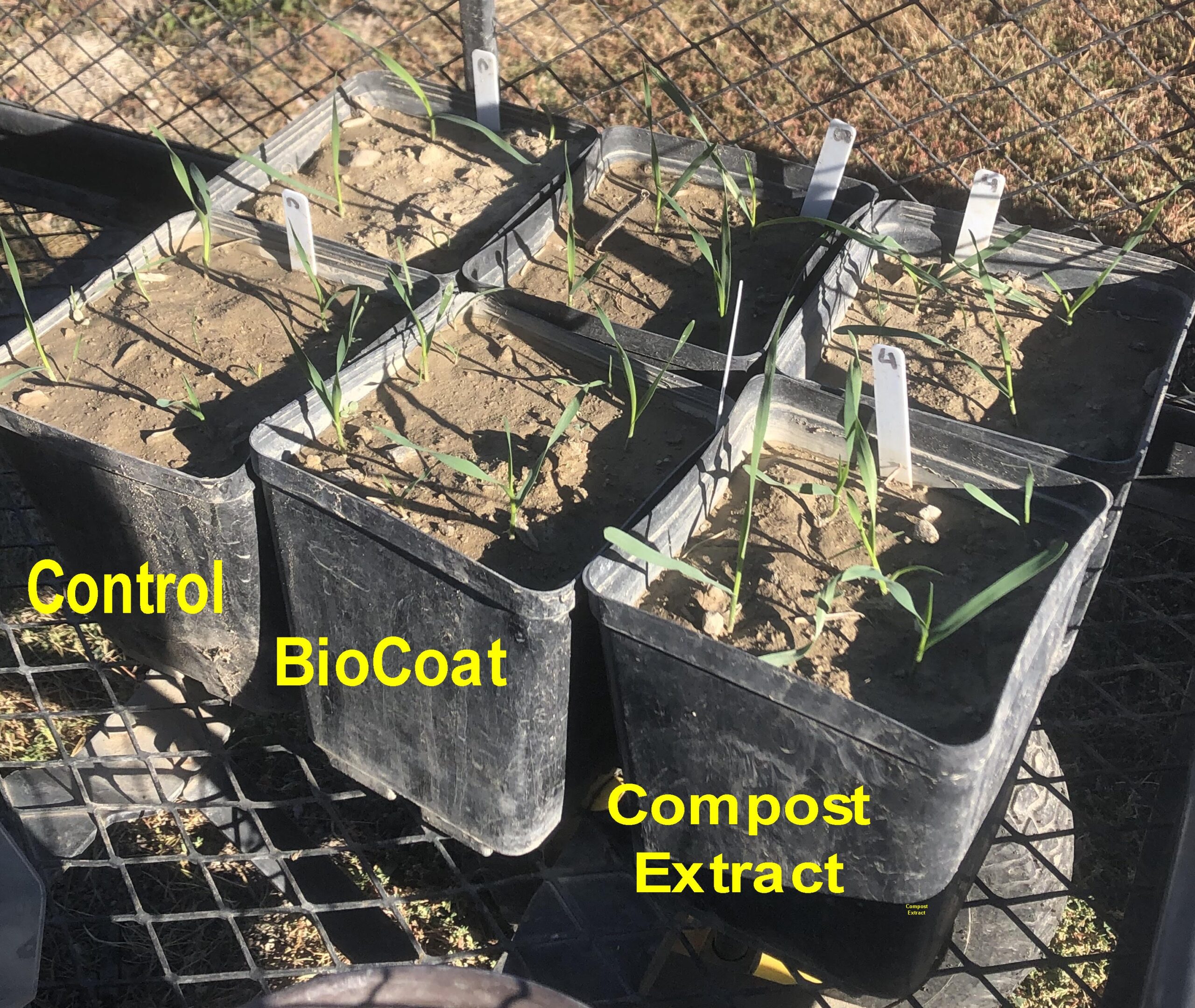
As a foliar spray, it gives plants the tools to fight insects, develop nutrition and persist in harsh conditions. Extract also works as a root and cuttings dip. As an inoculant, it gives seeds a running start on all the soil microbes they need to build fertility as they grow. DePonte demonstrated this by planting 3 sets of seeds in the same soil at the same time. One set was not inoculated and served as a control. Another set was sprayed with BioCoat Gold, a commercial seed inoculant from Advancing Eco Agriculture known to increase seedling vigor and resistance to weather stressors, build robust root systems and supply critical endomycorrhizal fungi. The third set was treated with Greg’s compost extract. Both treated seed sets did better than the control, but Greg’s local treatment did best.
We can’t pin down what combination of microbes is enhancing plant growth, but it goes beyond just fertilizers. It’s the biology.
.