
My last article on biochar was in March 2023. You can read about Bigtime Biochar on Barreca Vineyards.com, but the project at Avista’s Waste to Energy Facility in Kettle Falls did not happen. There has been a lot of hype about biochar over the years and that project is a good example. Myno Carbon wanted to make biochar from wood waste in Kettle Falls and use it to absorb stock yard waste in Pendleton then sell the enriched product to farmers. The market did not pan out which brings into focus the question for this article, “What is Biochar and What is It Good For?”.
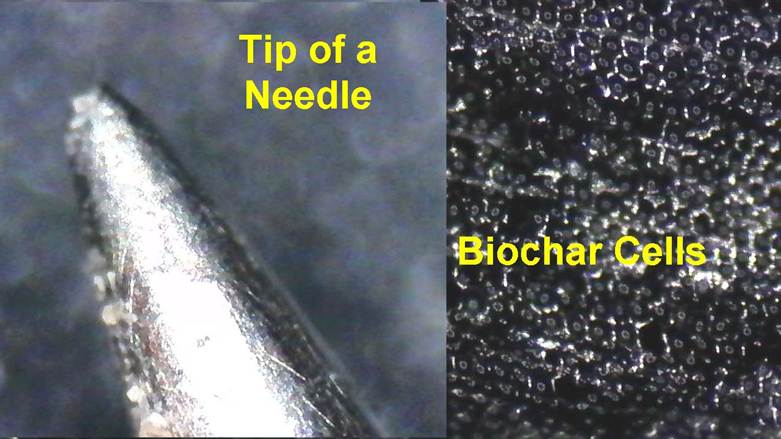
Basically, biochar is just charcoal without any additives or treatments which would turn it into charcoal briquettes. It can be made from grass, wood, branches, chips etc. by burning it to drive off the volatile gasses and then extinguishing the fire before it turns to ash. This leaves a residue that is almost entirely pure carbon and does not deteriorate over long periods of time. It has been produced for centuries because it smokes less than wood when used for cooking. Charcoal has millions of tiny cells that can absorb water and hold on to it without letting it evaporate. Those cells can serve as microbe hotels preserving diverse biology in almost any situation.
Cranking up the way-back machine, we read in Albert Bates’ book The Biochar Solution, about the adventures of Spanish friar, Gaspar de Carvajal who served Conquistador Francisco Pizarro as he and a contingent of 56 soldiers under the command of Francisco de Orellana descended the Coca River on into the Amazon River in search of gold and cinnamon in 1542. At one point they were attacked by women warriors who Carvajal wrote were “very white and tall and have very long hair…They carry scimitar knives and bows and even if you shoot them with arrows in their arms, they still fight a much as ten men.”
Carvajal’s journal of this trip was taken back to Spain and spawned the image that gave the Amazon River its name harkening back to the Amazons of Greek mythology. (Note “While long considered entirely mythical, modern archaeologists and historians have confirmed that these legends were likely inspired by real women. Excavations of ancient burial sites across the Eurasian steppes (modern-day Ukraine, southern Russia, and Kazakhstan) have revealed graves of nomadic Scythian women buried alongside their weapons, battle armor, and war horses.”) (Google and Smithsonianmag.com).
This relates to biochar because Carvajal and the Spaniards passed through continuous towns and cities along over 240 miles of the river. The cities were never separated by more than 3 miles and had roads stretching back away from the water. (This advanced civilization of millions of people later died from European diseases.) The Spaniards noted many outcrops and cutbanks of rich black soil supporting fruit trees and field crops along the way. In 1871 at the request of the Brazilian Government, Charles Hart and students from Cornell University explored mineral assets of the country and attributed the rich soil to “kitchen middens” which Herbert H. Smith described as “the refuse of a thousand kitchens for a thousand years.”
If this is beginning to sound like a civilization-wide compost pile, it is because it basically was. Analysis of the soil found shells, bones, skins, vegetable matter, pottery, wood, human waste and myriad other waste streams piled onto these middens. In our society these waste streams are all diverted to septic systems, landfills, waste water plants, incinerators etc. In Amazon basin societies, everything that once was alive or came directly from the earth like pottery, ended up in these middens and was broken down by bacteria and fungus into its smallest organic components from which it could become alive once again.
The dark black color of this rich “terra preta” (precious earth) soil comes from charcoal. But besides the color, charcoal, which does not break down beyond its essentially pure carbon form, maintained the fertility of that soil for thousands of years in the tiny pores of its cellular structure. Those pores provide water and shelter for microbes, especially bacteria. Bacteria are the chemical engineers of the microbial world. They consume whatever food source they need until it is gone and then wait for it to be available so they can multiply again or be themselves consumed by other bacteria and microbes. Once filled with biology, biochar becomes a biome ready to happen.
Too often biochar itself is considered a fertile soil amendment. Actually, pure fresh charcoal, right out of the fire, is sterile. It does not enrich the soil. It does help with other issues by retaining water in sandy soils, sequestering carbon and decompacting clay soils. After it is filled with biology, it becomes an even better soil nutrient than raw compost and maintains that role for years.
Two immediate implications are that biochar, once loaded with microbes, only needs to be added to your soil once. It is not like manure, bone meal and other amendments that are used up during the growing season. Also, biochar needs to be immersed in rich biology to become valuable just as it was in the middens of the Amazon.
I used to enrich biochar by spraying it with compost tea, preferably aerated compost tea to preserve mycorrhizal fungi. Lately, compost extract, made by rinsing the microbes from compost into water, seemed like a better idea. Delving into that idea raised the question of how much mycorrhizal fungi is going to be in typical compost given that mycorrhizal fungi need to be attached to plant roots to be able to feed on glucose from the plant leaves. One suggestion is to plant squash or some other fast-growing plant on your compost to keep the fungi alive. Another is to add fungal spores to the extract.
My latest solution is to just go Amazonian native. Add the biochar right into your compost pile. It will soak up microbes like a sponge. Keep it wet and active, then work the compost into your soil.