More important than wine for this website is that it displays blog posts about regenerative agriculture and personal posts about our life here. The latest is on top and a topic index is on the left site of the page. A printed compilation of articles, Nurturing Abundance, is also available from this website.
I have started collecting seeds. I have Bok Choy seeds from plants started this year and carrot seed from a carrot left in the ground over winter. There are thousands of them, enough to plant a whole field. We found out last year that seeds grown locally have adapted and do much better than commercial seeds. The abundance surprised me. Then I started looking at everything we eat. In many cases the seed itself is the food and especially with fruit, there is always a seed inside.
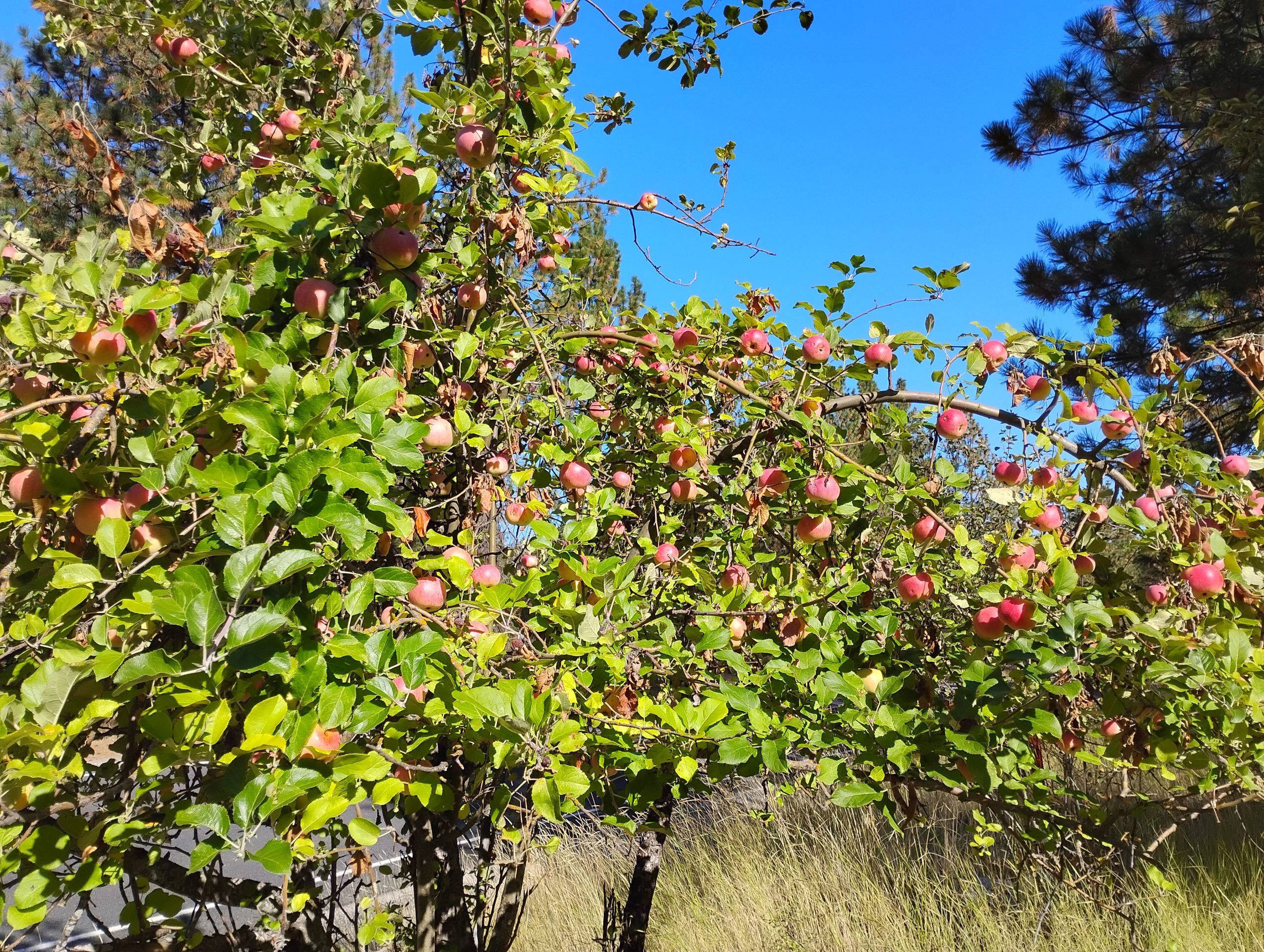
We had a warm wet winter with little snow. Apple trees have responded with huge crops everywhere I look, though where there is no irrigation, they can be small. The heat and dry weather did more than spark huge wildfires. Many crops are stressed and animals are stressed too. Bears, turkeys, birds and bees have devoured fruit and berries that my neighbors and I grew. You can’t blame them. Climate change is affecting us all.
Feeling a little stressed myself, a new book caught my attention, I Eat the Stars How To Live Fully and Beautifully in a Collapsing World by Sarah Wilson. The title is strange but she explains that it is line from a poem by Rebecca Elson that starts “Sometimes as an antidote to fear and death, I eat the stars.” The collapsing world part of the title hit home. I don’t see the climate getting better in spite of new techniques and technologies.
Neither does Wilson. I liked that she is considered a philosopher and has interviewed hundreds of experts and done research in fields related to collapse. As a result, she includes great quotes. She invites us to read the first 3 chapters and decide if we want to read the rest. Chapter 1, Hope, has a quote from Liam Neeson. “The growth-based comfortable existence is over.” Chapter 2, Relief, includes a story from James Stockdale, who survived being held prisoner by the North Vietnamese. He relates that the other prisoners who relied on hope of release “died of a broken heart.” Chapter 3, Truth, concludes that making sense is more important than turning out like we wanted. Wilson advises us that giving up hope of maintaining the status quo leads to relief. Count me in.
Then she bears down on collapse with a quote from Ralph Waldo Emerson: “The end of the human race is that it will eventually die of civilization.” We are getting more of that end-of-the-human-race part with dire predictions about artificial intelligence lately. Wilson sees no way out of climate change and says AI will fail because it tries consume all of our water and energy. “The Titanic is going down and we’re debating the right way to fold the deck chairs.” Part of the problem is “our collective inability of pay attention.”
This year my attention has become attuned to centralization. Noting that despite all the hype about seeds from big companies, they are not necessarily better, I am doubting that any information from big companies is the unvarnished truth. They often offer solutions to problems we are familiar with such as diseases, poverty or poor crops. That is the situation where Wilson introduced me to a new word, moloch. Moloch is an ancient Canaanite deity associated with child sacrifice in the Bible. The term later evolved into a metaphor for any brutal force or system that demands terrible human costs. Wilson associates it with a cascade of events with outcomes the opposite of the intended one. A simple example would be people in the front row of a concert standing up, forcing everyone behind them to do the same. A more devastating one is the nuclear arms race where nuclear weapons developed by one country induce others to do the same or worse. Innumerable other examples follow the same trajectory such as more powerful AI or research into bioweapons or pesticides that insects inevitably evolve resistance to.
A common moloch thread is the rise of authorities promising solutions to problems but demanding the loss of freedom or representation in return. When the situation gets bad, she writes “There are of course god-awful opportunists out there doing the work of vultures – investment firms, Big Tech, Big Pharma, Big Ag, Big Oil, the broligarchy…” Wilson cites Clay Shirky: “Institutions will try to preserve the problems to which they are the solution. That’s what they do.” (For instance, I see money going into cancer research for a cure but very little going into prevention.)
The crisis Wilson addresses reinforce each other. Climate change makes financial insecurity and inequality worse. Inequality fosters war. War makes diesel fuel more expensive. Transportation costs make food and everything else more expensive etc. We have seen the “hockey stick” picture of the increased effects of global warming. Wilson paints all of these as having their own hockey stick graphs. Anything that seems to be slipping will only get worse and do so much faster as time goes on. Sarah Wilson and I agree that this is not necessarily a picture of unavoidable doom. It is a picture instead of unsustainable growth in the face of natural laws. She first quotes Kenneth Boulding. “Anyone who believes in indefinite growth in anything physical in a physically finite planet is either mad or an economist.” Then Wilson quotes Gaya Herrington on why economists are so keen on growth. “Growth is the only way poverty can be eliminated without the rich having to give up something.”
What everyone has to give up on is complexity. Her studies show that complexity causes civilizations to collapse. Any disruption in the supply chain, people’s health, or a million other things can trigger a tipping point to collapse. She advocates that we start making our lives simpler right now by working with nature. Nature will force us to live more simply one way or another. People I have interviewed who lived through the “Great Depression” recount moving to cities to find work but returning because the countryside has steady work and healthy food. We have a head start on simplicity.
There is more to this than living simply. No one person has all the answers but we all want to survive and have something to contribute. Wilson says we can start to find those ideas using the 3 C’s, collaboration, cooperation and communication. There are more ideas in this book than will fit in one article much like the abundant seeds that nature gives us. As David Fleming wrote, Sarah Wilson asks us to “draw inspiration that has lain dormant, like the seed beneath the snow.”
My last article on biochar was in March 2023. You can read about Bigtime Biochar on Barreca Vineyards.com, but the project at Avista’s Waste to Energy Facility in Kettle Falls did not happen. There has been a lot of hype about biochar over the years and that project is a good example. Myno Carbon wanted to make biochar from wood waste in Kettle Falls and use it to absorb stock yard waste in Pendleton then sell the enriched product to farmers. The market did not pan out which brings into focus the question for this article, “What is Biochar and What is It Good For?”.
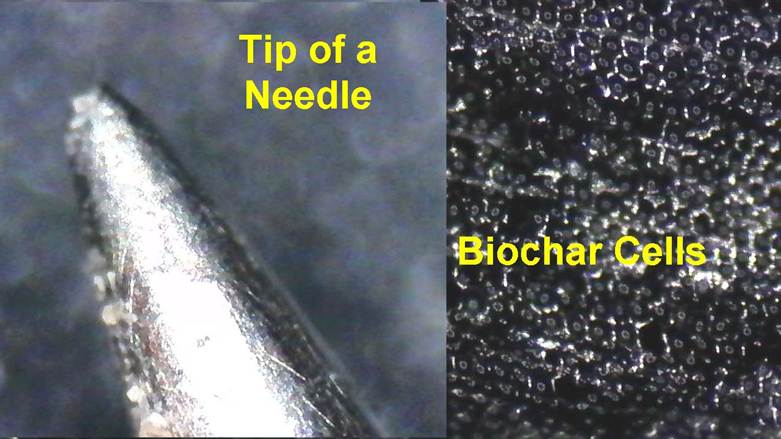
Basically, biochar is just charcoal without any additives or treatments which would turn it into charcoal briquettes. It can be made from grass, wood, branches, chips etc. by burning it to drive off the volatile gasses and then extinguishing the fire before it turns to ash. This leaves a residue that is almost entirely pure carbon and does not deteriorate over long periods of time. It has been produced for centuries because it smokes less than wood when used for cooking. Charcoal has millions of tiny cells that can absorb water and hold on to it without letting it evaporate. Those cells can serve as microbe hotels preserving diverse biology in almost any situation.
Cranking up the way-back machine, we read in Albert Bates’ book The Biochar Solution, about the adventures of Spanish friar, Gaspar de Carvajal who served Conquistador Francisco Pizarro as he and a contingent of 56 soldiers under the command of Francisco de Orellana descended the Coca River on into the Amazon River in search of gold and cinnamon in 1542. At one point they were attacked by women warriors who Carvajal wrote were “very white and tall and have very long hair…They carry scimitar knives and bows and even if you shoot them with arrows in their arms, they still fight a much as ten men.”
Carvajal’s journal of this trip was taken back to Spain and spawned the image that gave the Amazon River its name harkening back to the Amazons of Greek mythology. (Note “While long considered entirely mythical, modern archaeologists and historians have confirmed that these legends were likely inspired by real women. Excavations of ancient burial sites across the Eurasian steppes (modern-day Ukraine, southern Russia, and Kazakhstan) have revealed graves of nomadic Scythian women buried alongside their weapons, battle armor, and war horses.”) (Google and Smithsonianmag.com).
This relates to biochar because Carvajal and the Spaniards passed through continuous towns and cities along over 240 miles of the river. The cities were never separated by more than 3 miles and had roads stretching back away from the water. (This advanced civilization of millions of people later died from European diseases.) The Spaniards noted many outcrops and cutbanks of rich black soil supporting fruit trees and field crops along the way. In 1871 at the request of the Brazilian Government, Charles Hart and students from Cornell University explored mineral assets of the country and attributed the rich soil to “kitchen middens” which Herbert H. Smith described as “the refuse of a thousand kitchens for a thousand years.”
If this is beginning to sound like a civilization-wide compost pile, it is because it basically was. Analysis of the soil found shells, bones, skins, vegetable matter, pottery, wood, human waste and myriad other waste streams piled onto these middens. In our society these waste streams are all diverted to septic systems, landfills, waste water plants, incinerators etc. In Amazon basin societies, everything that once was alive or came directly from the earth like pottery, ended up in these middens and was broken down by bacteria and fungus into its smallest organic components from which it could become alive once again.
The dark black color of this rich “terra preta” (precious earth) soil comes from charcoal. But besides the color, charcoal, which does not break down beyond its essentially pure carbon form, maintained the fertility of that soil for thousands of years in the tiny pores of its cellular structure. Those pores provide water and shelter for microbes, especially bacteria. Bacteria are the chemical engineers of the microbial world. They consume whatever food source they need until it is gone and then wait for it to be available so they can multiply again or be themselves consumed by other bacteria and microbes. Once filled with biology, biochar becomes a biome ready to happen.
Too often biochar itself is considered a fertile soil amendment. Actually, pure fresh charcoal, right out of the fire, is sterile. It does not enrich the soil. It does help with other issues by retaining water in sandy soils, sequestering carbon and decompacting clay soils. After it is filled with biology, it becomes an even better soil nutrient than raw compost and maintains that role for years.
Two immediate implications are that biochar, once loaded with microbes, only needs to be added to your soil once. It is not like manure, bone meal and other amendments that are used up during the growing season. Also, biochar needs to be immersed in rich biology to become valuable just as it was in the middens of the Amazon.
I used to enrich biochar by spraying it with compost tea, preferably aerated compost tea to preserve mycorrhizal fungi. Lately, compost extract, made by rinsing the microbes from compost into water, seemed like a better idea. Delving into that idea raised the question of how much mycorrhizal fungi is going to be in typical compost given that mycorrhizal fungi need to be attached to plant roots to be able to feed on glucose from the plant leaves. One suggestion is to plant squash or some other fast-growing plant on your compost to keep the fungi alive. Another is to add fungal spores to the extract.
My latest solution is to just go Amazonian native. Add the biochar right into your compost pile. It will soak up microbes like a sponge. Keep it wet and active, then work the compost into your soil.
Diversity and abundance are the hallmarks of a healthy ecosystem. They are apparent when you are out in nature. But what about the ecosystem underground? A pretty sure indication of health is an abundance of earthworms. If those are not visible, how do you check for diversity and abundance in your soil? To answer that I have always wanted a microscope. Now I have one.
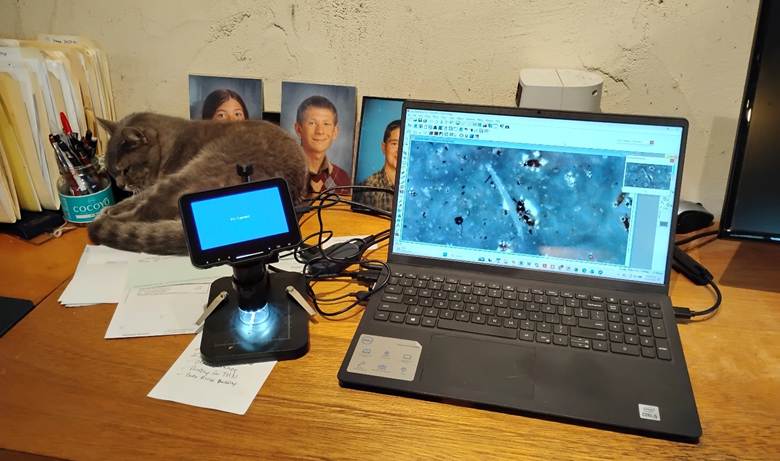
It doesn’t look like the classic binocular heavy metal instrument you would expect. Instead, it is another device that is made in China and plugs into the USB port on your computer. It gives me 1000x power magnification to look at microbes and lets me take pictures and video among other things. Also, it cost $45 instead of $300.
What pushed me over the edge to start doing this myself was a talk and tour given at the Stevens County Soil Conservation District on April 4th by Claudia Shimkus. She studied under Dr. Elaine Ingham, who is famous for coining the term “Soil Food Web” and drawing attention to the world of microbes interacting with plants and the rest of the ecosystem under our feet.
Claudia started the class not with a microscope but with a presentation on compost. The presentation quickly began to focus on air and water. To be more specific, she talked about two kinds of composting techniques, vermicompost and thermal compost. Thermal compost takes advantage of the tendency of compost materials such as fresh grass and offal to quickly raise the temperature of a compost pile to 160º F. (Above that it needs to be turned to prevent it from catching fire.) In the process it kills weed seeds and possible plant pathogens in 3-8 weeks. The heat builds up because air is not flowing through the pile. It is anaerobic.
In vermicompost organic matter is decomposed by bacteria and fungi in 3-6 months. Worms and other organisms survive because enough air goes through the pile to let them breathe and stay cool. In the case of worms, the pile also stays warm enough to keep them from freezing in the winter. But there is much more going on than differences in temperature and it has to do with what organisms thrive in aerobic and anaerobic conditions.
Bacteria are fine in water and in moist air. Fungi need both water and air. The roles they play are very different. Think of bacteria as the alchemists of the underground. They breakdown organic matter into molecules that can be eaten by other organisms. They do the same for minerals. Minerals need to be in organic molecules before plants can use them. Bacteria also serve as food for many bigger and more complex critters because they are very small. There are a billion bacteria in a teaspoon of healthy soil. Scientists determine the variety of bacteria by analyzing DNA. They estimate 30,000 per teaspoon. We are a long way from figuring out how all these kinds of bacteria do what they do. Under a microscope, they look like tiny dots which change shape but don’t move around much.
Fungi are the economic, information, defense and transportation system for life underground. In broad terms they are categorized as saprophytic and mycorrhizal. Saprophytic fungi are the usually-white molds that grow on wet leaves and rotting logs. They break down organic matter so other microbes can eat it but they are not much help underground. They appear as white strands under a microscope.
Mycorrhizal fungi bond to the roots of plants and form a symbiotic relationship. They live on sugars and sap from the plants. Only green leaves in sunlight can produce sugars. In exchange the mycorrhizal fungi bring water and minerals from long distances to a plant’s roots amplifying the area that supplies nutrients many fold. These fungi know what nutrients will be helpful to the plant. They have also been seen trapping harmful microbes before they can attack plant roots. 90% of plants have a beneficial relationship to mycorrhizal fungi. So, identifying, promoting and protecting that relationship is key to soil health. They appear in darker colors with uniform strands stretching across the field of view in a microscope, but you don’t usually see many of them in compost extract. (We will get back to why shortly.)
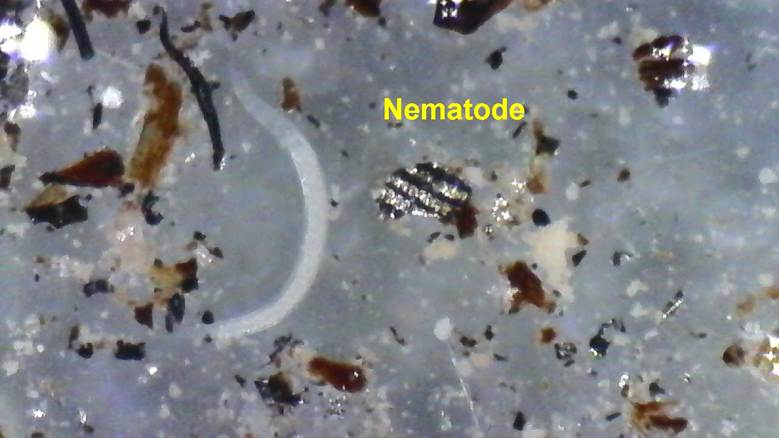
What you do see are nematodes, arthropods, amoeba and other protozoa. They are bigger, easier to identify and to quantify. They are the next step in the Soil Food Web. They eat bacteria and fungi. They poop out organic matter that helps soil structure, moisture, ventilation and drainage.
In Claudia Shimkus’s class we were focused on nematodes in compost extract. She prefers compost extract to compost tea. Compost tea is made by suspending a permeable bag such as a sock, filled with compost in warm water and adding some sugar, fruit juice or similar nutrient that bacteria can feed on, and waiting a day or so for the microbes to multiply. Add an aquarium air pump and it becomes aerobic compost tea. Compost extract is made by soaking some compost in water (I prefer rainwater.) then straining out the bigger pieces of organic matter. It is fast and preserves fungi, bacteria and protozoa. Compost tea promotes bacteria and becomes anaerobic quickly leaving mostly bacteria and dead protozoa.
In his excellent book The Biochar Solution, Albert Bates states “If you see any predatory nematodes in the samples, count that compost and tea as being extra beneficial.” Nematodes are also known as round worms. As a lifeform there are more nematodes on earth than any other. There are several kinds. The ones known for eating holes into your carrots are small. A healthy growth of mycorrhizal fungi will strangle them before they get into the carrot. A predatory nematode is much larger and eats small nematodes. So, Bates is correct in counting them as beneficial.
The logical take-away is that if you have nematodes in your compost, it is healthy and you can use it to enhance your garden soil directly or by spraying compost extract. You can also soak biochar in compost extract and it will preserve the healthy biome and transfer it to whatever soil it is added to. Possibly unsaid, is that those living microbes are more beneficial to your soil than any mineral or chemical fertilizer you can add. These microbes create fertility on their own.
Now back to the lack of mycorrhizal fungi in compost extract. Mycorrhizal fungi live best attached to plant roots. Compost typically does not have plant roots. One solution is to grow plants in the compost until you use it. (My compost seems to supply its own squash seeds.) Another approach is to add mycorrhizal spores to compost and compost extract before you apply it.
I’m eager to sample my soil directly as well as leaves, feathers, ferns and a million other things in the same way I sample compost extract, under the microscope.
(NB: I planted squash in my compost as encouraged by FieldLark.AI but need to protect them now from deer.)
Both my mother an father grew up in large families, 7 kids each, on small farms in Missouri and Oregon. Both of them left their farms to fight in World War II, never to return to the farm. They went to college on the GI Bill after our triumph in the war. America went big in 1943. It built hundreds of big boats, big airplanes and big tanks. That took thousands of factories, huge supply chains and efficient logistics. They were both very proud of what the United States had done and what the country had become since they were kids growing up in the Depression.
By 1962 when I was in high school, we had super highways, super markets and super sonic airplanes. Meanwhile back on the farm, not much had changed. The New Deal’s Agricultural Adjustment Act of 1933 was providing price supports for small farmers costing a lot of tax money allowing farmers to live off the land, produce enough food to win a war and keep prices low. Government called in the captains of big business, the Committee for Economic Development (CED), to look at the problem. The 1962 “Adaptive Program for Agriculture,” proposed by the CED, resulted in a policy recommendation to solve agricultural “overproduction” by intentionally reducing the number of American farmers through government action, moving people to urban jobs, keeping commodity prices low, and promoting larger machinery to replace labor. It was a “bigger is better” approach that my parents would have believed.
This solution to the perceived problems reminds me of “Manifest Destiny”, the excuse for the decimation of indigenous peoples and their way of life as agriculture moved west. Both solutions frame their intent as facilitating a transition to an inevitable future. Both ignored the beauty, sustainability and healthy ecological diversity of the landscape they were transforming.
These recommendations were soon adapted into the Federal Manpower Development and Training Act and the 1965 Farm Bill. The first helped move young people into cities. The second retained price supports based on previous production whether new crops were planted or not. Note that fruits and vegetables were not supported. Producing corn, soy, wheat and meat gave the United States advantages in foreign markets. A balanced diet was not an objective.
Okanagan Tribal member, Chad Eneas at the En’owkin Centre in Penticton, BC described the commerce introduced by the fur traders as “extractive”. He explained how water that is part of the land where they live is sacred, but in our economy, it becomes just another commodity, trapped behind dams and rationed out to produce electricity. As such it becomes more valuable the further away from the source it can be taken. With the arrival of the trappers, the Salish word for beaver began to mean “money”. They trapped beaver to acquire specific goods such as knives and guns. But as with all of us, money came to mean wealth with no specific intention other than security, power and status. In our system to increase wealth you need to control the source of commodities and their distribution. If you extract commodities from their source, consolidate the supply of goods in warehouses and concentrate their distribution in stores, you control the price and accumulate wealth. Long distances between source, storage, sales and distribution increase value. They also increase the demand for fuel.
Over the 64 years since the CED recommendations, supply lines have become worldwide. Supermarkets have become supercenters. Millionaires have become billionaires. Family farms are endangered and now farmers have the highest suicide rate of any occupation. The average farmer makes 14 cents on every retail food dollar he produces (Pew Research). The average age of American Farmers is 59.5 years old. 73% of farmland is in holdings from 1000 to over 5000 acres in size. Still, there are a lot of small farms, 42% are under 50 acres (USDA). Rural populations such as ours are shrinking over most of the country but ours is growing though not as fast as urban areas.
Urban refugees are coming to rural Washington. The majority will not be farming for a living. In fact, even on family farms the average off-farm income was $82,809 in 2021 while the average income from farming was $210 (USDA). The opportunity to live without grid electricity or city water is increasing because of photovoltaics, electric cars and wireless communications. The ways to make a living on a farm but not from the farm have been increasing since the COVID epidemic.
Overall however, we still rely on the extractive food economy. My parents would not have believed that many rural areas are now considered “food deserts”. Food in our stores travels an average of 14,000 miles. The growing size of farms damages the ecology above ground and destroys the biology below the ground. The distances increase prices and decrease nutrition. (I will write more about the need to see food as medicine in a later article.) Just as we have new ways to build a more independent infrastructure, we also have ways to become more locally self-sufficient. These include farmers markets, community supported agriculture (CSAs) where consumers subscribe to food deliveries directly from farmers and local stores such as the Milk House, that stock locally-made products.
There is a growing trend of cottage food industries. We now have at least two bakeries in Northeast Washington specializing in sourdough bread for instance. Surprisingly, entrepreneurial businesses are more resilient in rural areas than cities (PBS). Cottage food is safe. There has never been an outbreak of foodborne illness from food sold under a cottage food law. The money and food exchange stays local and not extractive. The sources are transparent and directly responsive.
Still, there is often bureaucratic pushback through licensing, inspections, caps on total sales and training requirements. Washington State’s Cottage Food Law allows individuals to produce non-potentially hazardous foods in home kitchens for direct sale to consumers, with a $35,000 annual gross sales limit. Permitted items include baked goods, jams, jellies, and dry mixes. A permit from the Washington State Department of Agriculture (WSDA) is required, costing $355 for two years, which includes a home kitchen inspection. Meat/poultry/fish (including jerky), canned veggies/salsas, dairy products, raw seed sprouts, and refrigerated bakery items are prohibited. We could do better. Washington is one of the 3 most restrictive states in the country on cottage food laws. For more information contact the Institute for Justice (ij.org) about their food freedom initiative. We can win this fight.
Take advantage of your disadvantages. Rachel Leiken
In the beginning of winter weather forecasters tell us about El Niño and La Niña. This year we got La Nada, an entirely open winter with record warm temperatures. This portends another very dry summer, record heat and high fire danger. Amidst that bad news it is a good time to make compost because compost needs heat.
Leaves vs Needles: Years ago, I hired a dump truck to bring 20 yards of leaves from the city leaf dump on highway 20 to my vineyard. Leaves from deciduous trees rot over winter into fertilizer and food for worms. Needles tend to rot slowly but burn quickly. The floor of a hardwood forest is rich and full of worms. I cleared a conifer forest to expand my vineyard and the ground is sandy, drains quickly and is has little fertility. With a dry year coming, I want something to hold moisture in the soil and add food for plants and microbes. I want more leaves.
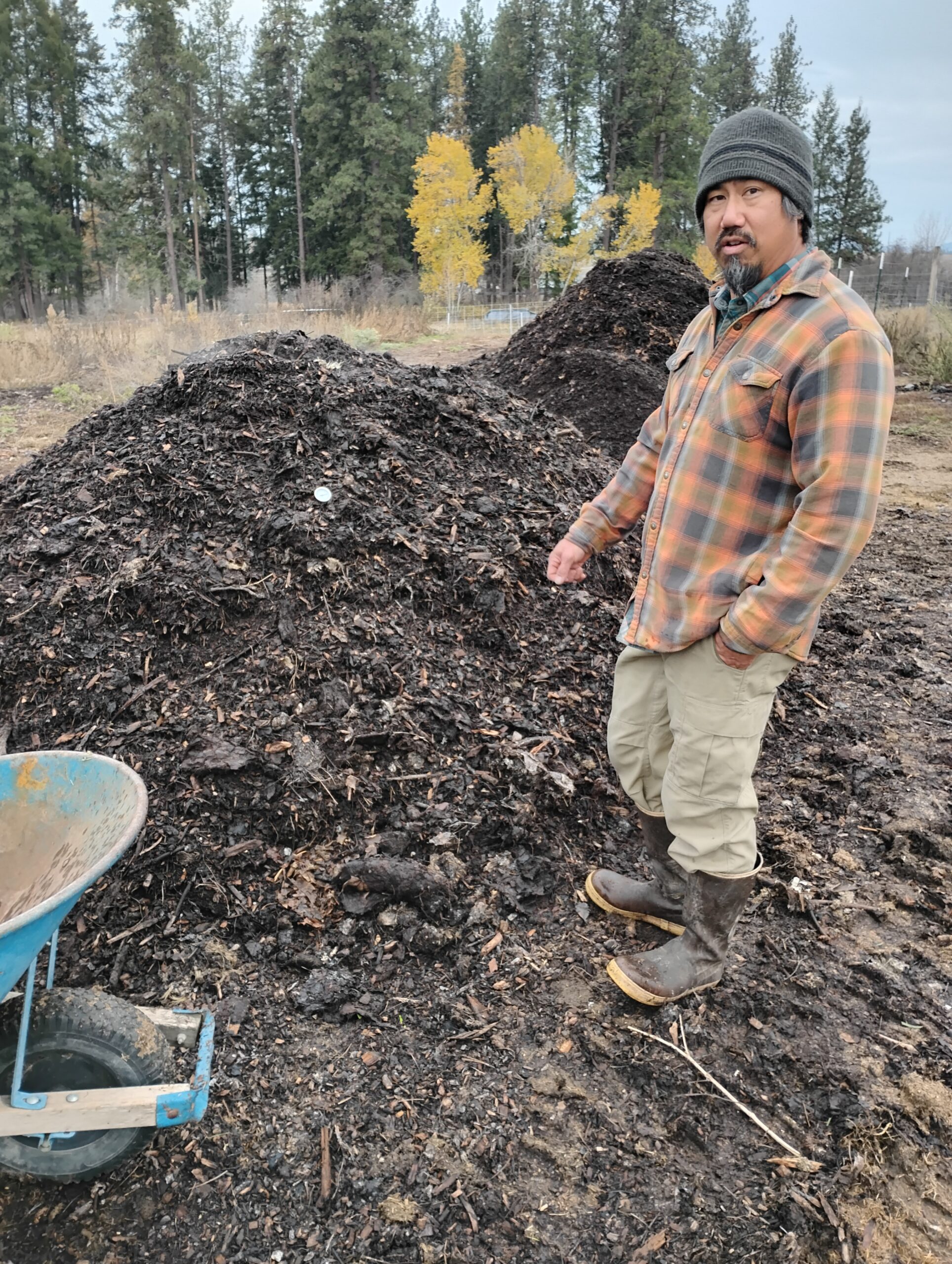
Greg DePonte working compost
Bigger vs Smaller: In a brilliant move, Greg DePonte, owner of Ola Aina Farms, made a deal with the City of Colville to dump those leaves on his farm just outside the city limits. It saves the city on time and gas and gives him huge piles of leaves. Size is an advantage in making compost quickly. Microbes like moisture, air and warmth, a lot like us. The wet start to winter brought in the moisture. Big piles build up the heat, especially when it is not too cold outside. But if they get to be much over 160º F, the microbes tend to die off and the pile can even catch fire. Greg needs to monitor the temperature closely and turn the piles when they get too hot.
Bacteria vs Fungus: He takes samples of the compost to a specialist to determine the ratio of bacteria to fungus. You need both. Bacteria can break down organic matter and transform it into organic compounds that are easily assimilated into plants. Fungus thrives on the products of bacteria. It also transports them to plant roots where it receives sugars from the photosynthesis that plants build in sunlight. The symbiotic relationship of mycorrhizal fungi to plants through their roots makes both of them healthy. Fungus needs air to breath. Bacteria can become anaerobic and do just fine in water. You want your compost to have lots of fungi and your soil to breathe as well.
Johnson-Su vs Piles: The best compost by many reports comes from a Johnson-Su Bioreactor. A mixture of plant material and manure is stacked in wire cages with screening cloth to keep it contained. Perforated pipe is inserted vertically to make sure it breathes. After a while the perforated pipe can be removed and the holes remain. The compost develops over time without being turned. After a few months, up to a year, the wire cage is removed and the compost is ready to use. A single teaspoon of finished compost can have a billion microbes in it. Jillian and Ryan Garrett, owners of Blue Ridge Farms, use this compost directly to make soil blocks where seeds can grow with no plastic or other containers. A ton of Johnson-Su compost can sell for $15,000 or more to commercial farmers who use it to inoculate their fields with biology.
Greg DePonte can achieve similar results with turning and another ingredient, offal. Yes, animal body parts left from butchering can enhance compost. They breakdown quickly because they increase the heat of a pile dramatically. Rich in calcium, phosphorous and other essential elements, this component of compost is seldom used in small backyard systems because it can attract pests. In a hot, well-managed system, it speeds the process and increases the diversity. DePonte raises hogs, sheep and cows on pure organic feed. So, he has good livestock to work with and lots of leaves.
Compost Extract vs Aerated Compost Tea: Talking with Greg, I became more aware of some uses of compost that have not gotten much attention. We normally think of compost as something we make at home or comes in bags and is added to the soil in the garden. As a soil amendment like bonemeal, bloodmeal or chicken manure compost certainly has a place in making more nutrients available to plants. But going back to that bit about the billions of microbes in a teaspoon of finished compost, it is that living part of the preparation that brings the vitality home.
For years I have been touting the benefits of compost tea, particularly aerated compost tea. Because it is aerated by bubbling an aquarium air pump through the liquid, aerated compost tea favors fungi more than plain compost tea. Both are made by suspending a bag or sock full of compost in water for a day or so. The key is that you also put other things in with the compost to feed the microorganisms, usually molasses, sugar or even honey. That feeds the yeast and other microorganisms and they multiply rapidly, dividing every 20 minutes or so. Over 24 yours each original microbe becomes 6 quadrillion copies of itself, (assuming that it does not run out of food). Saturating biochar with that liquid makes each piece an inoculant with a cornucopia of microorganisms. But as biochar it is still a soil amendment. Also, you have tipped the scales heavily toward biology that feeds on sugar.
Even in aerated compost tea, the wide variety of biology is limited by its food preference. On the other hand, compost extract can be a balanced mix of anaerobic and aerobic. To make it, you put a handful or more of compost into a 5 gallon bucket half full of water. Stir it with a drill-mounted paint mixer and strain it through cloth. That shakes the biology loose from the plant cell substrate and mixes it with the water. From there it can be diluted 10 times for use. It needs to be used withing a day or so, otherwise the anaerobic part fades and the fungi etc. die.
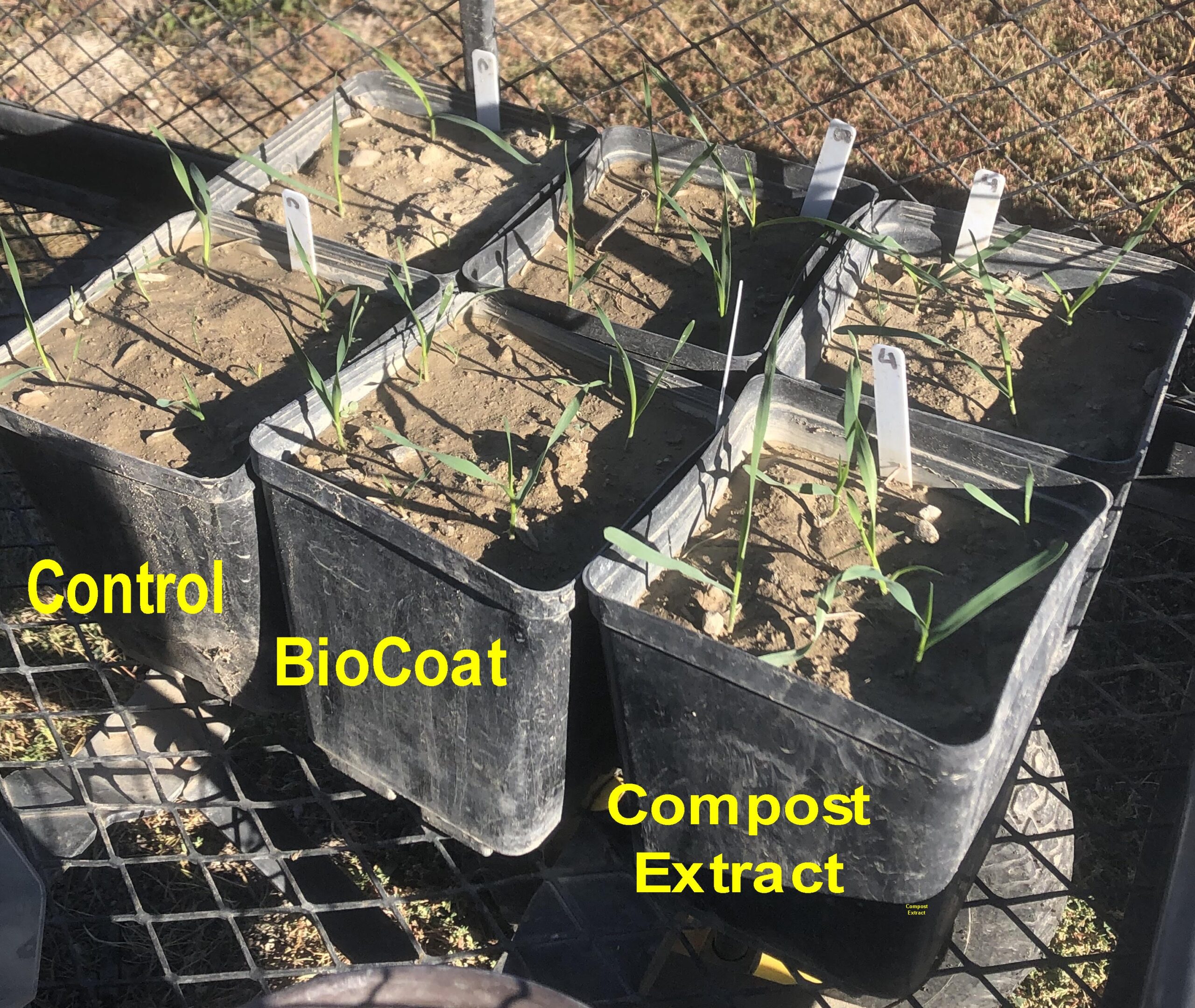
As a foliar spray, it gives plants the tools to fight insects, develop nutrition and persist in harsh conditions. Extract also works as a root and cuttings dip. As an inoculant, it gives seeds a running start on all the soil microbes they need to build fertility as they grow. DePonte demonstrated this by planting 3 sets of seeds in the same soil at the same time. One set was not inoculated and served as a control. Another set was sprayed with BioCoat Gold, a commercial seed inoculant from Advancing Eco Agriculture known to increase seedling vigor and resistance to weather stressors, build robust root systems and supply critical endomycorrhizal fungi. The third set was treated with Greg’s compost extract. Both treated seed sets did better than the control, but Greg’s local treatment did best.
We can’t pin down what combination of microbes is enhancing plant growth, but it goes beyond just fertilizers. It’s the biology.
As the area of our knowledge grows, so does the perimeter of our ignorance. Neil deGrasse Tyson
When my wife, Cheryl and I were in Lamington National Park, QLD, Australia, we learned about Red Bull Ants. They have nothing to do with the soft drink but do have unusual powers. “They are characterized by their extreme aggressiveness, ferocity, and painful stings. Some species are known for the jumping behavior they exhibit when agitated.” (Wikipedia) A lot like yellowjackets but on the ground, if you step on one, they release a pheromone and the whole colony runs to that place in attack mode. It is best to leave quickly, which we did when necessary.
Ants are usually characterized as a very low life form without much intelligence. But they exhibit collective behavior that in the context of ant colonies refers to the coordinated actions and interactions of individual ants that result in the emergence of complex, organized patterns at the colony level. (insectlore.com). As humans we tend to think of ourselves as superior. We expect ants to get out of our way, which they usually do. But there is another way to look at ant behavior; the migration of birds; the colonies of bees; the intelligence of Octopuses and many other creatures in our environment. It is called Pervasive Universal Consciousness, PUC. (There are other similar terms.)
The implications of the PUC model are profound, challenging deeply held assumptions about individuality, free will, and the nature of reality. If consciousness is indeed universal, it implies that all living beings—and even inanimate objects—are interconnected through a shared field of awareness. (wisdomschool.com) “What if consciousness is not something special that the brain does but instead is a quality inherent to all matter?” (scientificamerican.com) Among the implications of PUC are that decades of research trying to pin down consciousness to a specific area of the brain have been useless. But they go beyond that. (The Vedas are the foundational texts of Hinduism.) “Modern physics is searching for a unitary field of consciousness to explain the coherence of the laws of nature. Such a universal consciousness is proposed as existing behind all time, space and energy. It is the ultimate frontier of knowledge.” (vedanet.com)
If you are about to doubt that this is a valid way to understand the universe, don’t expect science to back you up. Although science demands replicable proof and peer review, the basis of peer review itself is doubt. As a scientist, if you just send your studies to people who think the same as you, you have not done your job. Send them to a skeptic first.
Since I am not a scientist, I often see things that make me skeptical but about which I know little to nothing. One was titled “Spellers”. These turn out to be autistic people who have motor disabilities that don’t allow them to speak out loud or type. They communicate by pointing to an alphabet one letter at a time. This allows them to have someone write what they are thinking. They think very clearly. Several were featured who were getting college degrees. Many were telepathic with their assistants. (telepathytapes.com) Admitting this happens implies that we have been shortchanging a growing part of the population for years.
These kinds of abilities are often grouped as PSI (or psychic) phenomena. PSI research include anecdotes of precognition, telepathy, clairvoyance, synchronicity, memories of past lives, out-of-body experiences, and other unusual experiences. (Google AI) In that vein it is instructive to look at the studies that are going on at the University of Virginia Department of Perceptual Studies. A study there that caught my attention last year was of children who remembered who they were in past lives. In many cases researchers were able to figure out what those past lives were and confirm that what the children were saying was true.
The immediate implication is that this life is not our only shot. The Vedic and Tibetan traditions that you can literally be born again are valid. That was a big relief. I am hoping to rectify some screwups from my younger years. Of course, the years ahead don’t look particularly promising so that might not be such a good thing.
The U of V’s Dept of Perceptual Studies has other research on out-of-body experiences, (I have had two brief ones); near death experiences, vision at a distance and after-death communication. All of these studies challenge the material universe as we understand it.
Somewhere on the border between the spiritual and the material is quantum entanglement, famously called “spooky action at a distance” by Einstein. One implication that has been confirmed in numerous experiments is that two linked particles stay linked at all distances from each other, making change in one is reflected in the other faster than the speed of light can convey information. Harnessing this ability is the holy grail of quantum computing but other implications seem to be possible such as quantum teleportation.
Before we go completely “beam me up Scotty” I need to retrace what got me going on this line of thought. It was a review of The Age of Disclosure. I had no idea what that was about so I looked it up. It’s about UAPs, known to us older folks as UFOs, Unidentified Arial Phenomena, Unidentified Flying Objects, flying saucers… whatever you want to call them. There was a splash earlier in the year when video was released by the Defense Department of objects seen by pilots doing seemingly impossible maneuvers at incredible speeds in the air and underwater. The Age of Disclosure is a movie with interviews of the pilots themselves talking about their experiences. The implications here are literally out-of-this-world. Besides defying physics as we understand it, there are a host of alien abduction accounts, crop circles and as I discovered, a whole study of exopolitics, “diplomacy with visitors from other planets”. (Oxford Academic) This is necessary because we have gone way past “flying saucers”. There are all kinds of UAFs and their passengers in the literature. This implies two things right off. First, just as our technology seems to be developing in leaps and bounds, we would expect theirs to evolve too. Secondly if they were out to destroy us, we would be gone already. Of course there are conspiracy theories on this.
Which brings me back to the ants. We might fancy ourselves as advanced beings that your average ant would barely have a concept about. But there is a lot going on where we are the ants and that we have no concept about. A bit like an ant, I am not imagining what I could do about any of this, so I am going on about the business of food and lodging and sometimes late at night pondering the implications.
100 years ago, my grandfather sold boxes of apples door to door in St. Louis. He picked them up at the train station. They were labeled “Kettle Falls”. Lenore Bible and her brother worked after school nailing apple boxes together in Kettle Falls to make money for their family after their father died in an accident at work.
80 years ago, chemical companies which made potassium nitrate, an ingredient in gunpowder, during WWII began selling it as chemical fertilizer. Soon, nitrates and pesticides derived from chemical warfare were polluting the soil, air and water. In 1962 Rachel Carson wrote Silent Spring.
Tilth Conference 2025
51 years ago, author and farmer Wendell Berry spoke at Expo ’74 in Spokane, delivering a speech called “The Culture of Agriculture” at the “Agriculture for a Small Planet” symposium. His speech criticized corporate agriculture and inspired the formation of the Tilth movement, an organization focused on organic, sustainable farming. After the symposium, Berry encouraged those who were interested in alternative agriculture to gather, which led to the first Northwest Conference on Alternative Agriculture in Ellensburg, Washington. Over 800 of us attended that conference, where we formed the organization Tilth to support organic and sustainable farming practices in the Pacific Northwest.
45 years ago, Robert Rodale, son of organic farming pioneer J.I. Rodale, coined the term “regenerative organic agriculture” to describe farming practices that go beyond “sustainable” by actively improving the health of soil and other natural resources.
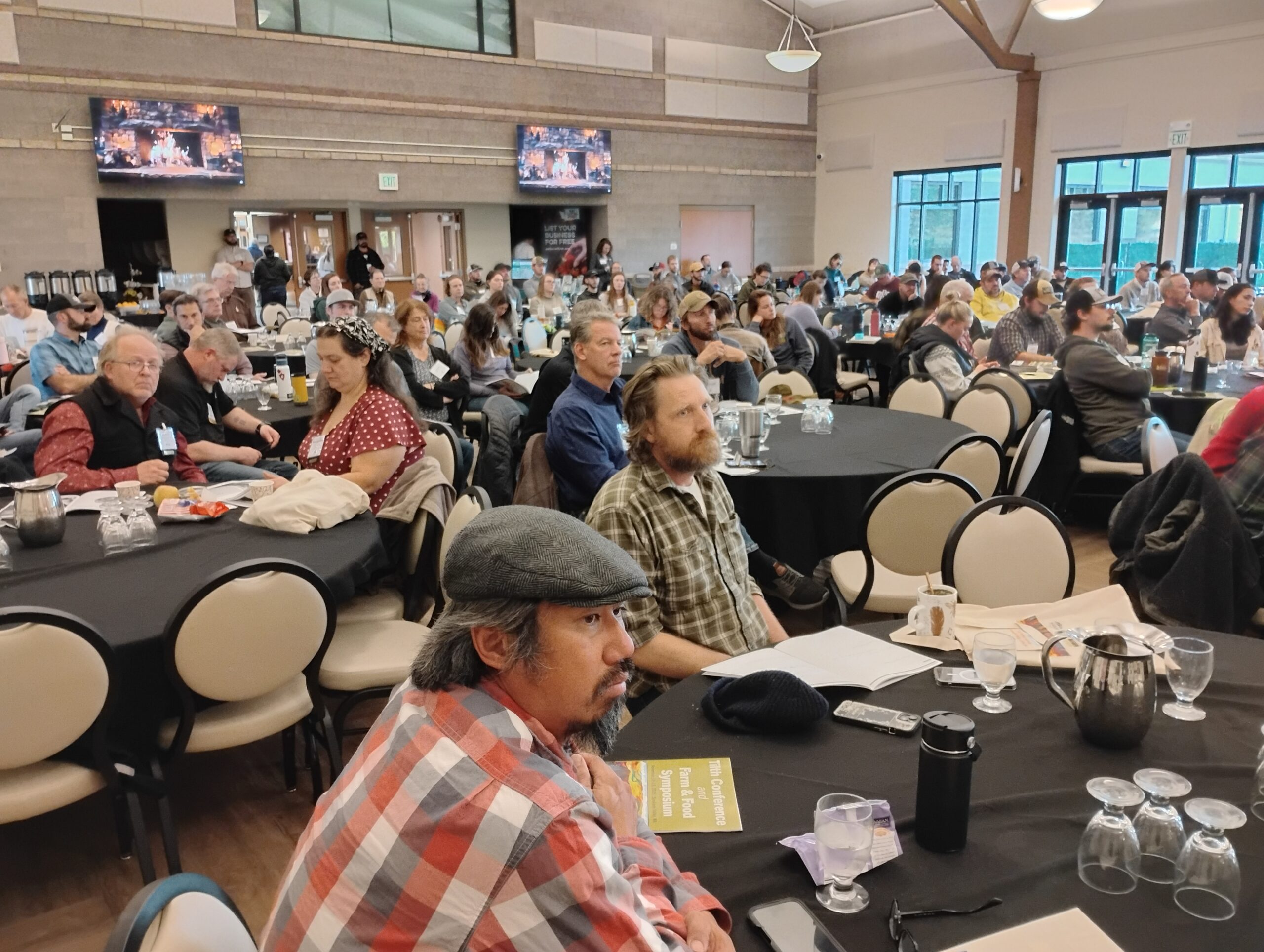
November 12th 2025, Tilth held a conference at the CenterPlace Regional Event Center in Spokane Valley in partnership with the Spokane Conservation District. Several of us attended that conference to learn about what is happening with Alternative Agriculture.
I am saying Alternative Agriculture because organic and regenerative products still amount to less than 5% of the food grown in the United State so they are still “alternative”. In one of the first general sessions at the conference we listened to farmers making the transition from completely commercial practices to regenerative agriculture. Their farms were large, thousands of acres. Today, the average farm size is 444 acres. 671,000 farmers managing small acreage farms vs. 46,000 farmers managing large farms. (usfarmdata.com) So 84% of our food comes from large farms averaging 5,500 acres or 8.6 square miles. The irony is that both large and small producers feel trapped in their production practices.
Large farms have over a million dollars of equipment, a host of employees and often lease payments, taxes and loans to repay. Only large agribusiness companies can handle their volume through commodity markets with low per unit pricing. Farmers often rely on government price supports that will only cover losses if the farms conform to general practices which include chemical fertilizers, herbicides and pesticides. Farmers markets and direct sales to consumers will not keep them in business. Their crops and seeds are often patented so they can’t grow their own seeds. Often the crops are genetically engineered to resist herbicides and need chemical fertilizers to grow. Large-scale Farmers need to sell to large-scale production facilities that turn their production into small items that the average consumer can afford. Even though regenerative practices produce the same amounts or more of grain, beans, livestock etc. at lower costs than conventional methods and sell for more than non-organic products, when selling to commodity brokers large producers can’t make more money per unit of output than conventional farmers. Those trying to make a transition have to take small incremental steps or risk losing the farm.
On the other end, small producers have to not only focus on their soil health and production, but they often have to process their own products, market those products and distribute them directly to consumers or to smaller local outlets. It is a lot more work, time and money for a smaller overall income. They need expertise and connections in more diverse areas per farm. So, it is hard for them to grow bigger.
The science is not standing still. People came to this conference to learn about new methods of testing, managing and increasing the health and diversity of their farms. Here are some of the innovations we heard about:
Sap Testing takes samples from both old and new growth to see what nutrients are being lost over time and need to be replaced.
DNA analysis identifies not just the linage of the crop but also of microbes and species that have symbiotic or parasitic relationships with it.
Reverse Osmosis is softening the hard water often pumped from wells and used for irrigation. It decreases disease and increases production.
Green Lightning is a technology that increases the nitrogen content of water with electricity, much like natural lightning does to rain water. It lessons the need for chemical fertilizers.
Microscopes are being used not just in the laboratory but also in the field to tell in real time what is happening with the plant, the soil and the biology on a farm.
More sophisticated methods of composting agricultural waste into fertilizer are making compost into its own product worth hundreds of dollars per ton.
Compost teas of many kinds can be made on the farm for fertilizers, pest control and plant health enhancement.
Bioextracts store longer, ship further, are more efficient and can be scaled to larger operations than compost teas.
Cover crops enrich the soil and protect it from being leached out or dried out. They can either be grown with a main crop or between harvest and planting.
In all of these things biology is becoming the key to increased health, production and biodiversity. Regenerative agriculture works by recognizing and leveraging the symbiotic relationships that nature already provides.
In our lifetime agriculture is trying to change dramatically. There are a lot of groups helping to make that happen. Tilth is partnering with many of them. Eat Local First was at the conference with maps showing local producers. Buying local keeps money in the community. Slow Food is International but focuses on local areas. Ours is Slow Food Upper Columbia, slowfooduppercolumbia.wordpress.com/. We meet almost every month to share food and friendship. The Huckleberry Range Community Collective https://www.facebook.com/groups/huckleberryrangecommunitycollective/ wants to make it more accessible and more affordable for your family and home to be self-sufficient, within a supportive and cooperative community. They share tools, seeds and supplies.
A good local all-around source of help and information on farming is the Stevens County Conservation District. You can talk to Darla Clowser, 509-684-7579. “Tilth” means “Ground suitable for sowing seeds.” We still have a lot of growing to do.
I have been writing about regenerative agriculture in the North Columbia Monthly for 5 years and for the last 3 years have been writing about the establishment of Hudson’s Bay Fort Colvile (sic) 200 years ago in the Silverado. This summer those two passions converged as I attempted to understand a Salish language word by visiting the En’owkin Centre in Penticton British Columbia. I learned a lot but can’t claim that I know Salish well or even come close to speaking it. Salish is a big language group with tribes speaking dialects in Northeast Washington, parts of British Columbia north of us and even on the west coast. The word that intrigued me is in the nsyilxcen dialect spoken by the Penticton Band of the Okanogan Nation.
The word is Tmixw. but I should backtrack a little to how this got started. In 2019 Friends of the Trees and other groups held the first Global Earth Repair Conference in Port Townsend. I managed to attend and some time later got a link from Global Earth Repair to a podcast by Jeannette Armstrong, an Okanogan Elder, about Tmixw. . It seemed to be a very important native way of understanding our duties as humans to reinforce the cycles of nature.
The first messages I reported about regenerative agriculture focused on soil health and bringing it back to life. As studies, experiences and conversations evolved it has become clear that regenerating is about symbiosis. No plant or animal lives without continual cyclic exchanges of air, water and nutrients with the environment and all other organisms. The more variety there is in any biome, the healthier it is. In fact, most organisms incorporate microbes, mycelia and parts of other living things with different DNA than their own in their cells, guts and roots.
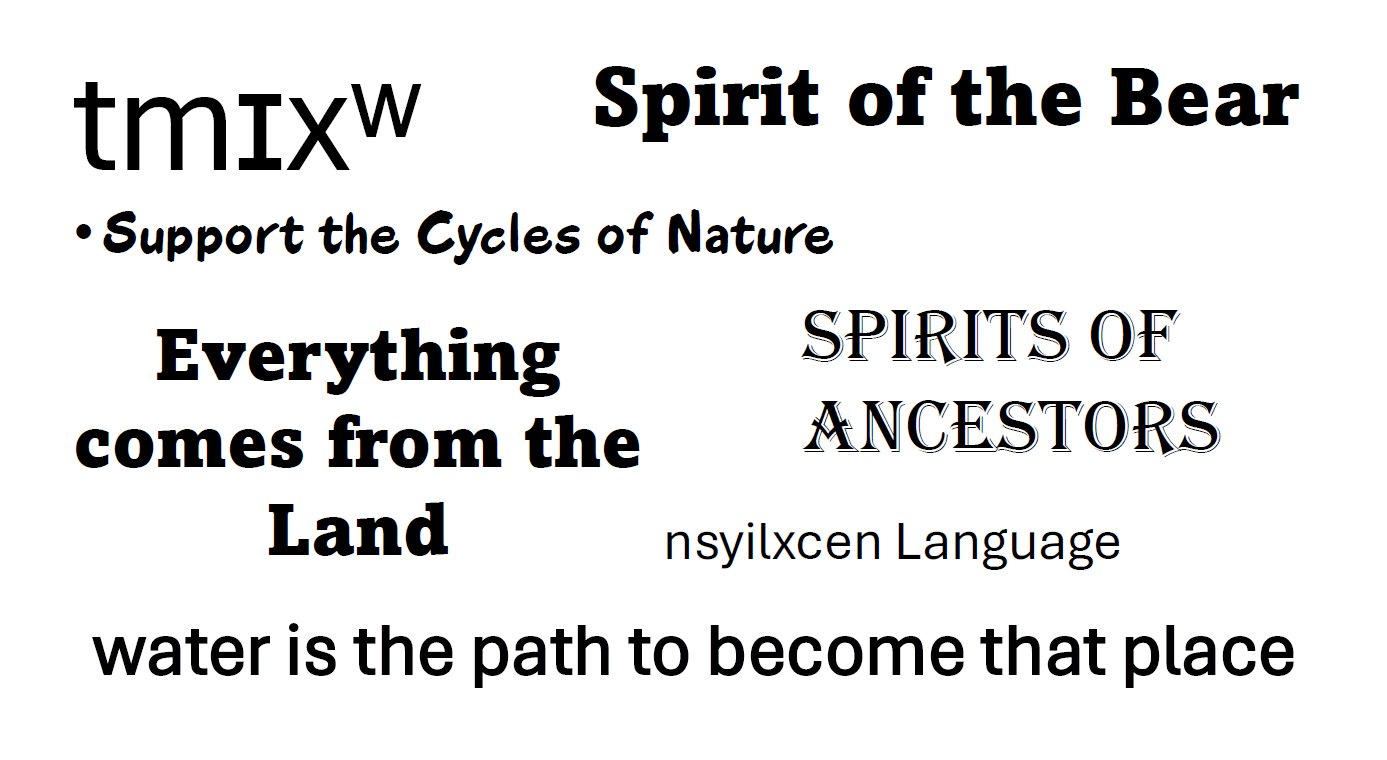
Tmixw. seemed to mean something similar. The last part, x w. is used in nsyilxcen to indicate anything that is cyclic in nature, which would be basically, everything in nature. The word itself has to do with the land. Jeannette’s brother, Richard Armstrong, is the traditional Salmon Chief at the Salmon Ceremony hailing the salmon to come back home. He reminds us that “Everything comes from the land.” The word for man is sqəiqəitmɪxʷ. See the Tmixw part at the end. We are part of the land. There is no direct “English” word for Tmixw. . Jeannette Armstrong treats it as something you participate in and learn about rather than translate. Some of the many implications are shown in the illustration: spirits of ancestors, spirit of the bear and other animals. “Water is the path to become that place” is a quote from her talk. At the En’owkin Centre Chad Eneas talked to us about water. He pointed out that our economy makes water something other than a part of the land. We pipe it, dam it, bottle it sell it and treat it as a chemical. The water on their tribal land comes down mountain valleys and keeps everything alive. It is sacred water. Salmon only return through free-flowing rivers. I mentioned to Chad my observation that we are mostly air. This sounds like a joke at first but when analyzed, our bodies are 96% made of elements in the air, carbon, nitrogen, oxygen and water. Chad pointed out the window of the En’owkin Centre to Black Cottonwoods, a sacred plant on their land and noted that we are continually exchanging air with those trees and all other plants and animals. We inhale oxygen from them and they inhale carbon dioxide from us. We are part of the same living system. There is no conflict between science and the native understanding of nature.
Every breath we take has been recycled millions of times between plants and animals over billions of years. We are keeping each other alive. We are saturated with the history and actually the future of every other living being. When I say, “I am still here.” I am thinking “I am still alive on the earth.” When the Sinixt tribe puts “We are still here” under their tribal logo, they are saying “We are still in this place where we have always been.” But if you think of each breath as coming from the plants around us and going back to them, of each drink of water we take and much of the food we eat as coming from the land and going back to the land, you have to admit that we are not just in this place, we are this place.
It’s not something we have a choice about or even need to be conscious of. Jeannette Armstrong invites everyone to participate in Tmixw. . If we do it consciously with the intent of learning from and regenerating the abundant nature of the land, we can help repair the earth.
It’s a little like the Zen saying “Be Here Now.” In Buddhist terms it probably means something more like “Pay attention to what you are doing and what is going on around you.” I know if I am doing one thing and thinking about something else (which I often do) I screw up. But if I relax a bit, take a deep breath and realize that the earth has my back and is keeping me alive, I feel at one with everything. Try it. Take a deep breath and enjoy Tmixw.
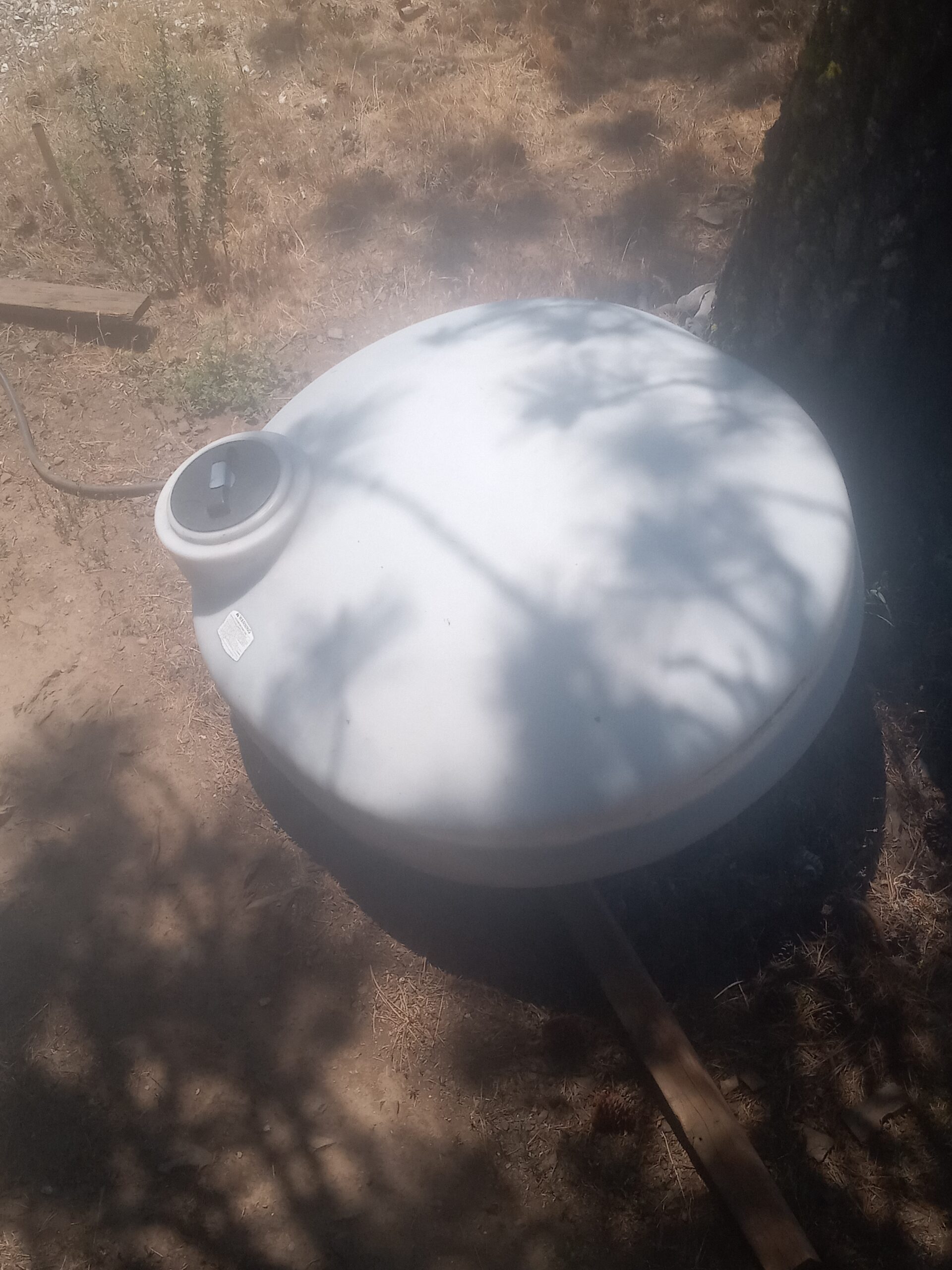
It was a dry winter and June was a dry month. A lot of us farmers are worried about the lack of water. Still more folks are worried about fire danger. With water in mind, earlier this Spring I started collecting rainwater off the metal roof of my office building. We have been using it to water indoor house plants ever since one that I put outside under a drip from the roof did much better than it did when kept inside and given tap water. We also use rainwater as drinking water for our pets and even in the pot on the wood stove that humidifies the house. Our well water is pretty hard. It picks up a lot of calcium carbonate and iron percolating through the native limestone. Water from the sprinkler will stain the sides of a building orange. The cats prefer drinking rainwater caught outside in a bucket to water from a faucet. Our dog is not very fussy about that. Typical dog.
rainwater cistern
So, what is it about rainwater that the plants and animals like so much? Right off, there is the fact that rainwater is soft. There are no mineral contaminants to taste or build up in the water heater. Soft water also works better with shampoo and surfactants that make foliar spray stick to leaves. But there is a lot more to rain than not having minerals.
It does have an important element, nitrogen. Bacteria inside plants can convert nitrogen from rain into chlorophyll that performs photosynthesis in leaves. It also has oxygen, helpful for all living organisms. So, gases in rainwater are important. Having collected rainwater from the roof, I see a lot more in it than gases. In later winter when the roof had been scrubbed by ice and snow the water was clear. But as Spring busted out it turned yellow with pine pollen. Then as the ground dried out it had dust. With warmer weather mosquitoes moved in and now every open container has its own black water beetle or two. Not exactly something you want to drink.
I have a funnel with a fine sieve to clean most of that up. The pets and plants don’t mind and the sprayer is okay but I’m not drinking our rainwater any time soon. People do drink rainwater. In Australia we saw most houses had 5000-gallon cisterns on each corner of the house. It was illegal to use city water or even well water for washing your car or watering the lawn. A house would typically have two sets of pipes, one for ground water and another for rainwater. Where we live, it is illegal to build a home without an outside source water.
A local family lives in an Earthship. They do have a source of well water but they prefer rainwater from their 7000-gallon cistern. It’s not a straight-forward under-the-edge-of-the-roof collection system. The roof is designed to collect water and all the surfaces are approved for potable water. The first step in cleaning up the water is to have it run through a scupper of loose gravel that removes larger debris. Like the rest of the Earthship, the cistern itself is made of tires filled with rammed-earth which are then held in place by concrete. The inside is coated with a non-toxic sealant. The rainwater enters at the bottom of the cistern where dust etc. settles and is cleaned out occasionally. It does not amount to much. Coming out of the cistern, water goes through a water organizing module “that filters out bacteria and contaminants, making it suitable for drinking. The WOM consists of filters and a DC-pump. Water is then pushed into a conventional pressure tank to create common household water pressure.” (Wikipedia) drinking water is filtered to a higher standard and comes from a separate spigot at the sinks. The first use of the clean water besides drinking is for bathing and washing dishes and clothes. The “greywater” from those operations goes to interior plants and then to flushing toilets and from there to outside water for plants. Systems may vary but some things about water always need attention.
Water is the universal solvent. It picks up particles and chemicals from anything it touches. A friend of mine used to say, “Having a smoking end of a restaurant is like having a peeing end of a swimming pool.” Over the past few weeks, I could smell smoke one morning and a skunk the next. I’m sure my nose was picking up concentrations of parts per million if not parts per billion. Our noses are that sensitive because dangers and opportunities can affect us in very small quantities. Personally, I won’t even drink water shipped in plastic water bottles. Collecting very healthy rainwater from rubber, asphalt or painted surfaces can negate its value. Storing it in plastic cisterns is convenient and inexpensive, but I am reluctant to recommend that for human consumption.
Another friend of ours, Larry, collects rainwater much more efficiently than I do. He ducts it directly from the gutter on his metal roof and into several 250-gallon storage tanks. From there it continues its gravity-fed way to his garden and vineyard. Plants like water with a PH of 6 to 7. Groundwater in some forest conditions may be to acidic, 6 or lower. Rainwater is almost always very neutral, with a PH of around 7. The plants receiving rainwater from Larry’s cisterns are happy and healthy. HIs system is simple, inexpensive and easy to maintain. Since it does not need to be used for human consumption, there is no danger to people. Listen to the rhythm of the falling rain and save it for a non-rainy day.