
100 years ago, my grandfather sold boxes of apples door to door in St. Louis. He picked them up at the train station. They were labeled “Kettle Falls”. Lenore Bible and her brother worked after school nailing apple boxes together in Kettle Falls to make money for their family after their father died in an accident at work.
80 years ago, chemical companies which made potassium nitrate, an ingredient in gunpowder, during WWII began selling it as chemical fertilizer. Soon, nitrates and pesticides derived from chemical warfare were polluting the soil, air and water. In 1962 Rachel Carson wrote Silent Spring.
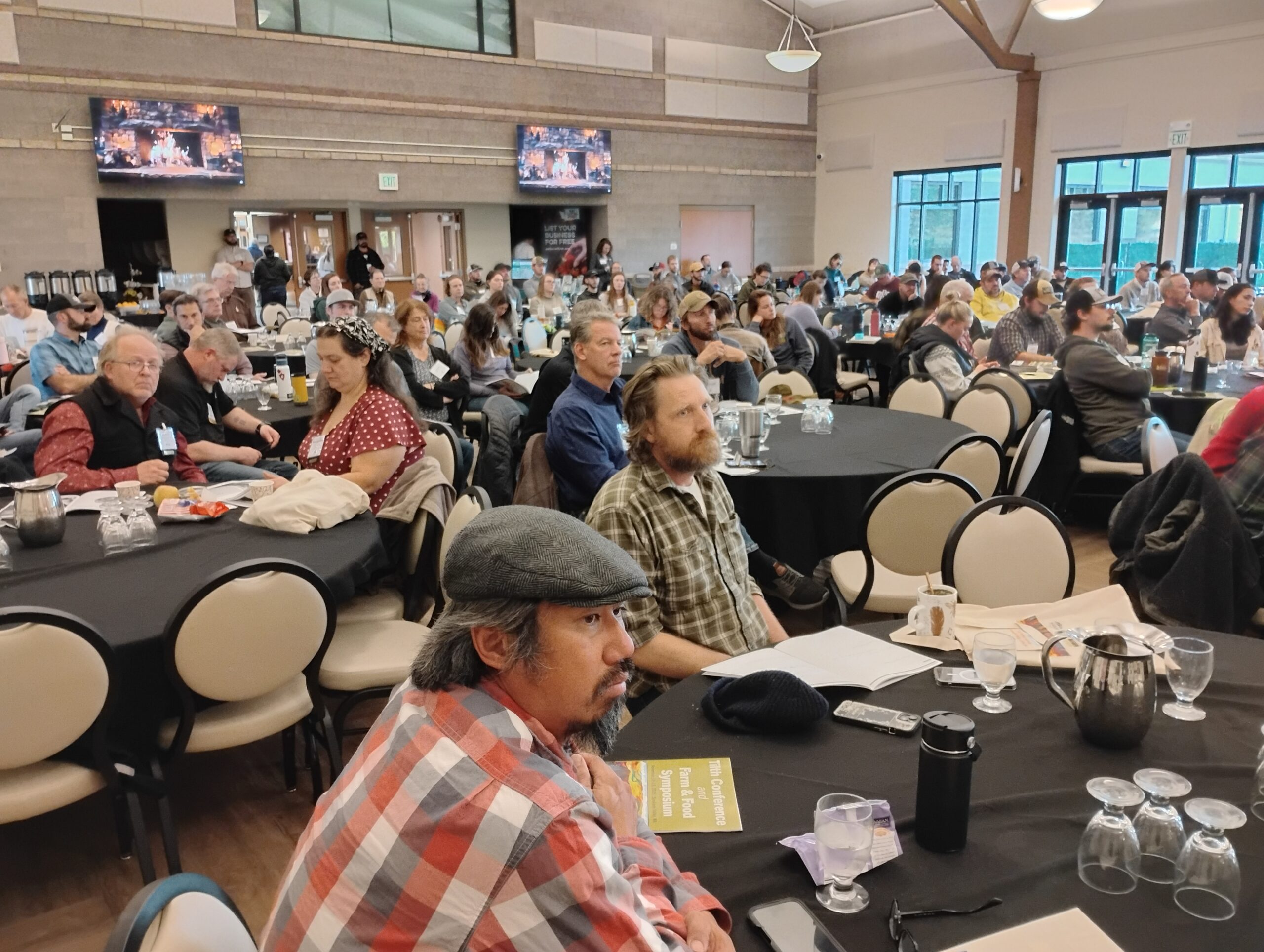
51 years ago, author and farmer Wendell Berry spoke at Expo ’74 in Spokane, delivering a speech called “The Culture of Agriculture” at the “Agriculture for a Small Planet” symposium. His speech criticized corporate agriculture and inspired the formation of the Tilth movement, an organization focused on organic, sustainable farming. After the symposium, Berry encouraged those who were interested in alternative agriculture to gather, which led to the first Northwest Conference on Alternative Agriculture in Ellensburg, Washington. Over 800 of us attended that conference, where we formed the organization Tilth to support organic and sustainable farming practices in the Pacific Northwest.
45 years ago, Robert Rodale, son of organic farming pioneer J.I. Rodale, coined the term “regenerative organic agriculture” to describe farming practices that go beyond “sustainable” by actively improving the health of soil and other natural resources.
November 12th 2025, Tilth held a conference at the CenterPlace Regional Event Center in Spokane Valley in partnership with the Spokane Conservation District. Several of us attended that conference to learn about what is happening with Alternative Agriculture.
I am saying Alternative Agriculture because organic and regenerative products still amount to less than 5% of the food grown in the United State so they are still “alternative”. In one of the first general sessions at the conference we listened to farmers making the transition from completely commercial practices to regenerative agriculture. Their farms were large, thousands of acres. Today, the average farm size is 444 acres. 671,000 farmers managing small acreage farms vs. 46,000 farmers managing large farms. (usfarmdata.com) So 84% of our food comes from large farms averaging 5,500 acres or 8.6 square miles. The irony is that both large and small producers feel trapped in their production practices.
Large farms have over a million dollars of equipment, a host of employees and often lease payments, taxes and loans to repay. Only large agribusiness companies can handle their volume through commodity markets with low per unit pricing. Farmers often rely on government price supports that will only cover losses if the farms conform to general practices which include chemical fertilizers, herbicides and pesticides. Farmers markets and direct sales to consumers will not keep them in business. Their crops and seeds are often patented so they can’t grow their own seeds. Often the crops are genetically engineered to resist herbicides and need chemical fertilizers to grow. Large-scale Farmers need to sell to large-scale production facilities that turn their production into small items that the average consumer can afford. Even though regenerative practices produce the same amounts or more of grain, beans, livestock etc. at lower costs than conventional methods and sell for more than non-organic products, when selling to commodity brokers large producers can’t make more money per unit of output than conventional farmers. Those trying to make a transition have to take small incremental steps or risk losing the farm.
On the other end, small producers have to not only focus on their soil health and production, but they often have to process their own products, market those products and distribute them directly to consumers or to smaller local outlets. It is a lot more work, time and money for a smaller overall income. They need expertise and connections in more diverse areas per farm. So, it is hard for them to grow bigger.
The science is not standing still. People came to this conference to learn about new methods of testing, managing and increasing the health and diversity of their farms. Here are some of the innovations we heard about:
Sap Testing takes samples from both old and new growth to see what nutrients are being lost over time and need to be replaced.
DNA analysis identifies not just the linage of the crop but also of microbes and species that have symbiotic or parasitic relationships with it.
Reverse Osmosis is softening the hard water often pumped from wells and used for irrigation. It decreases disease and increases production.
Green Lightning is a technology that increases the nitrogen content of water with electricity, much like natural lightning does to rain water. It lessons the need for chemical fertilizers.
Microscopes are being used not just in the laboratory but also in the field to tell in real time what is happening with the plant, the soil and the biology on a farm.
More sophisticated methods of composting agricultural waste into fertilizer are making compost into its own product worth hundreds of dollars per ton.
Compost teas of many kinds can be made on the farm for fertilizers, pest control and plant health enhancement.
Bioextracts store longer, ship further, are more efficient and can be scaled to larger operations than compost teas.
Cover crops enrich the soil and protect it from being leached out or dried out. They can either be grown with a main crop or between harvest and planting.
In all of these things biology is becoming the key to increased health, production and biodiversity. Regenerative agriculture works by recognizing and leveraging the symbiotic relationships that nature already provides.
In our lifetime agriculture is trying to change dramatically. There are a lot of groups helping to make that happen. Tilth is partnering with many of them. Eat Local First was at the conference with maps showing local producers. Buying local keeps money in the community. Slow Food is International but focuses on local areas. Ours is Slow Food Upper Columbia, slowfooduppercolumbia.wordpress.com/. We meet almost every month to share food and friendship. The Huckleberry Range Community Collective https://www.facebook.com/groups/huckleberryrangecommunitycollective/ wants to make it more accessible and more affordable for your family and home to be self-sufficient, within a supportive and cooperative community. They share tools, seeds and supplies.
A good local all-around source of help and information on farming is the Stevens County Conservation District. You can talk to Darla Clowser, 509-684-7579. “Tilth” means “Ground suitable for sowing seeds.” We still have a lot of growing to do.