
I have been writing about regenerative agriculture in the North Columbia Monthly for 5 years and for the last 3 years have been writing about the establishment of Hudson’s Bay Fort Colvile (sic) 200 years ago in the Silverado. This summer those two passions converged as I attempted to understand a Salish language word by visiting the En’owkin Centre in Penticton British Columbia. I learned a lot but can’t claim that I know Salish well or even come close to speaking it. Salish is a big language group with tribes speaking dialects in Northeast Washington, parts of British Columbia north of us and even on the west coast. The word that intrigued me is in the nsyilxcen dialect spoken by the Penticton Band of the Okanogan Nation.
The word is Tmixw. but I should backtrack a little to how this got started. In 2019 Friends of the Trees and other groups held the first Global Earth Repair Conference in Port Townsend. I managed to attend and some time later got a link from Global Earth Repair to a podcast by Jeannette Armstrong, an Okanogan Elder, about Tmixw. . It seemed to be a very important native way of understanding our duties as humans to reinforce the cycles of nature.
The first messages I reported about regenerative agriculture focused on soil health and
bringing it back to life. As studies, experiences and conversations evolved it has
become clear that regenerating is about symbiosis. No plant or animal lives without
continual cyclic exchanges of air, water and nutrients with the environment and all other
organisms. The more variety there is in any biome, the healthier it is. In fact, most
organisms incorporate microbes, mycelia and parts of other living things with different
DNA than their own in their cells, guts and roots.
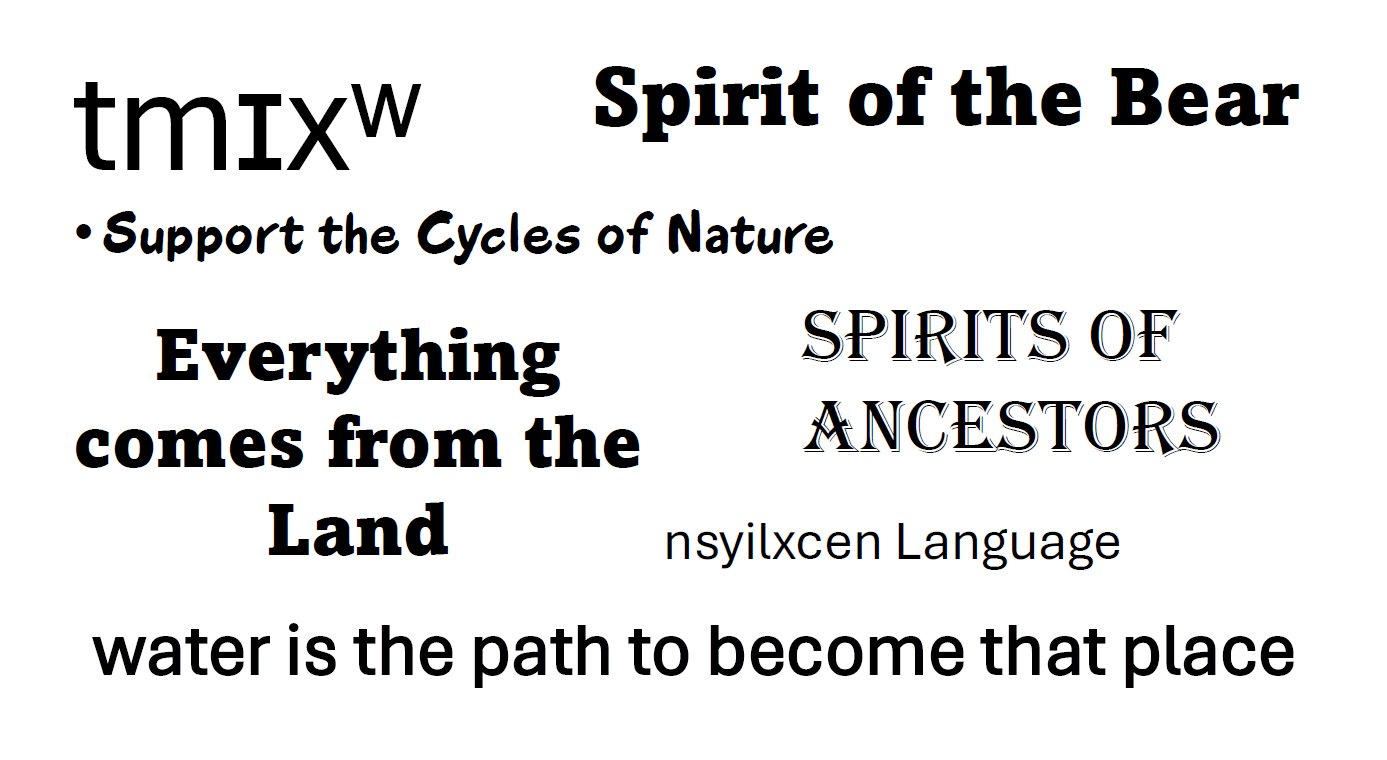
Tmixw. seemed to mean something similar. The last part, x w. is used in nsyilxcen to
indicate anything that is cyclic in nature, which would be basically, everything in nature.
The word itself has to do with the land. Jeannette’s brother, Richard Armstrong, is the
traditional Salmon Chief at the Salmon Ceremony hailing the salmon to come back
home. He reminds us that “Everything comes from the land.” The word for man is
sqəiqəitmɪxʷ. See the Tmixw part at the end. We are part of the land.
There is no direct “English” word for Tmixw. . Jeannette Armstrong treats it as something
you participate in and learn about rather than translate. Some of the many implications
are shown in the illustration: spirits of ancestors, spirit of the bear and other animals.
“Water is the path to become that place” is a quote from her talk. At the En’owkin Centre
Chad Eneas talked to us about water. He pointed out that our economy makes water
something other than a part of the land. We pipe it, dam it, bottle it sell it and treat it as a
chemical. The water on their tribal land comes down mountain valleys and keeps
everything alive. It is sacred water. Salmon only return through free-flowing rivers.
I mentioned to Chad my observation that we are mostly air. This sounds like a joke at
first but when analyzed, our bodies are 96% made of elements in the air, carbon,
nitrogen, oxygen and water. Chad pointed out the window of the En’owkin Centre to
Black Cottonwoods, a sacred plant on their land and noted that we are continually
exchanging air with those trees and all other plants and animals. We inhale oxygen from
them and they inhale carbon dioxide from us. We are part of the same living system.
There is no conflict between science and the native understanding of nature.
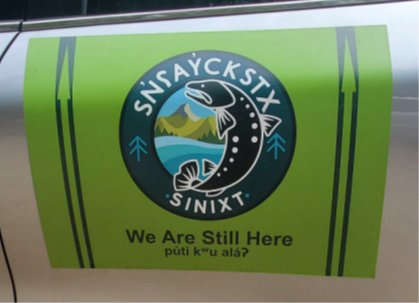
Every breath we take has been recycled millions of times between plants and animals over billions of years. We are keeping each other alive. We are saturated with the history and actually the future of every other living being. When I say, “I am still here.” I am thinking “I am still alive on the earth.” When the Sinixt tribe puts “We are still here” under their tribal logo, they are saying “We are still in this place where we have always been.” But if you think of each breath as coming from the plants around us and going back to them, of each drink of water we take and much of the food we eat as coming from the land and going back to the land, you have to admit that we are not just in this place, we are this place.
It’s not something we have a choice about or even need to be conscious of. Jeannette Armstrong invites everyone to participate in Tmixw. . If we do it consciously with the intent of learning from and regenerating the abundant nature of the land, we can help repair the earth.
It’s a little like the Zen saying “Be Here Now.” In Buddhist terms it probably means something more like “Pay attention to what you are doing and what is going on around you.” I know if I am doing one thing and thinking about something else (which I often do) I screw up. But if I relax a bit, take a deep breath and realize that the earth has my back and is keeping me alive, I feel at one with everything.
Try it. Take a deep breath and enjoy Tmixw.