
I have started collecting seeds. I have Bok Choy seeds from plants started this year and carrot seed from a carrot left in the ground over winter. There are thousands of them, enough to plant a whole field. We found out last year that seeds grown locally have adapted and do much better than commercial seeds. The abundance surprised me. Then I started looking at everything we eat. In many cases the seed itself is the food and especially with fruit, there is always a seed inside.
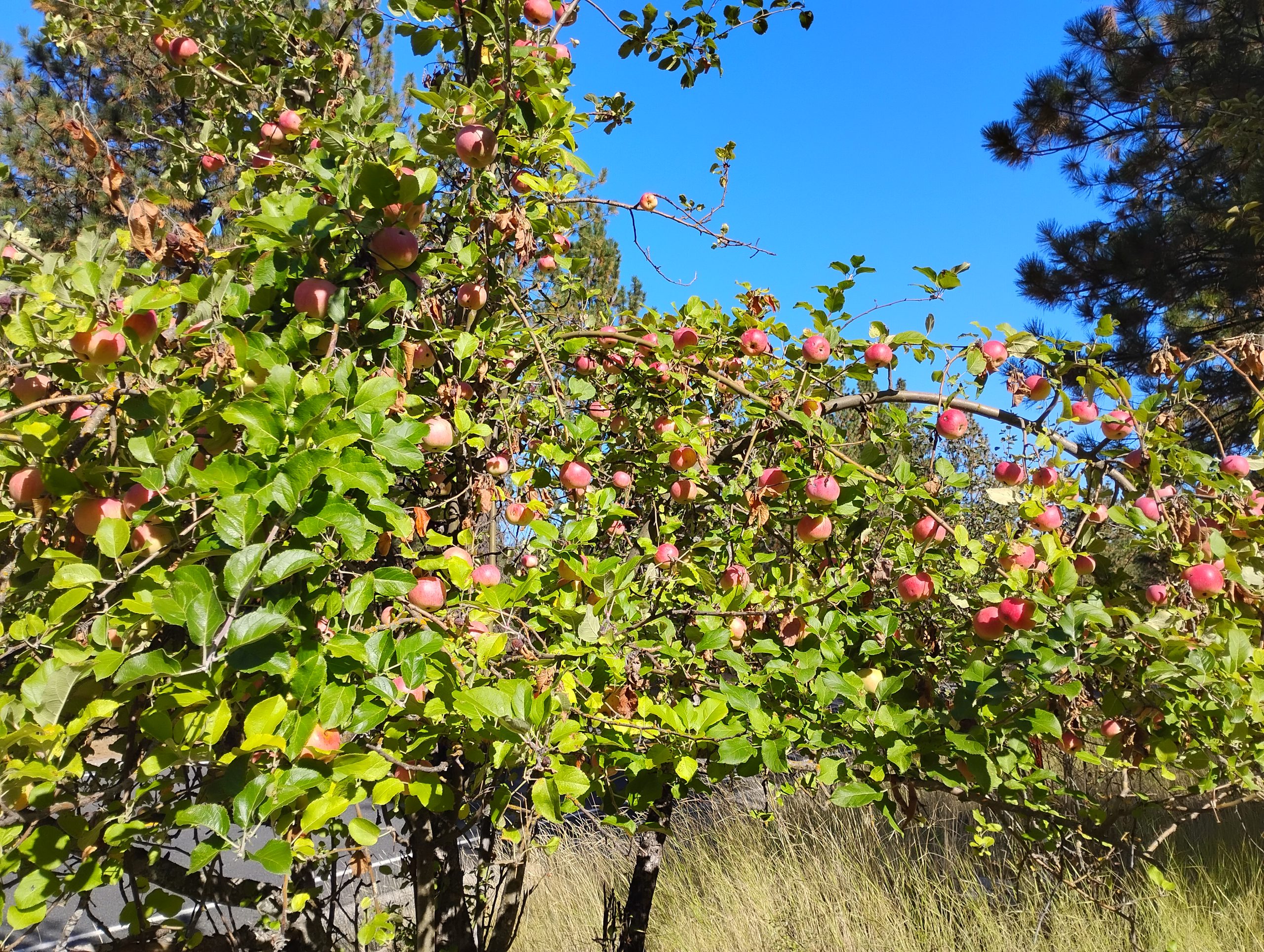
We had a warm wet winter with little snow. Apple trees have responded with huge crops everywhere I look, though where there is no irrigation, they can be small. The heat and dry weather did more than spark huge wildfires. Many crops are stressed and animals are stressed too. Bears, turkeys, birds and bees have devoured fruit and berries that my neighbors and I grew. You can’t blame them. Climate change is affecting us all.
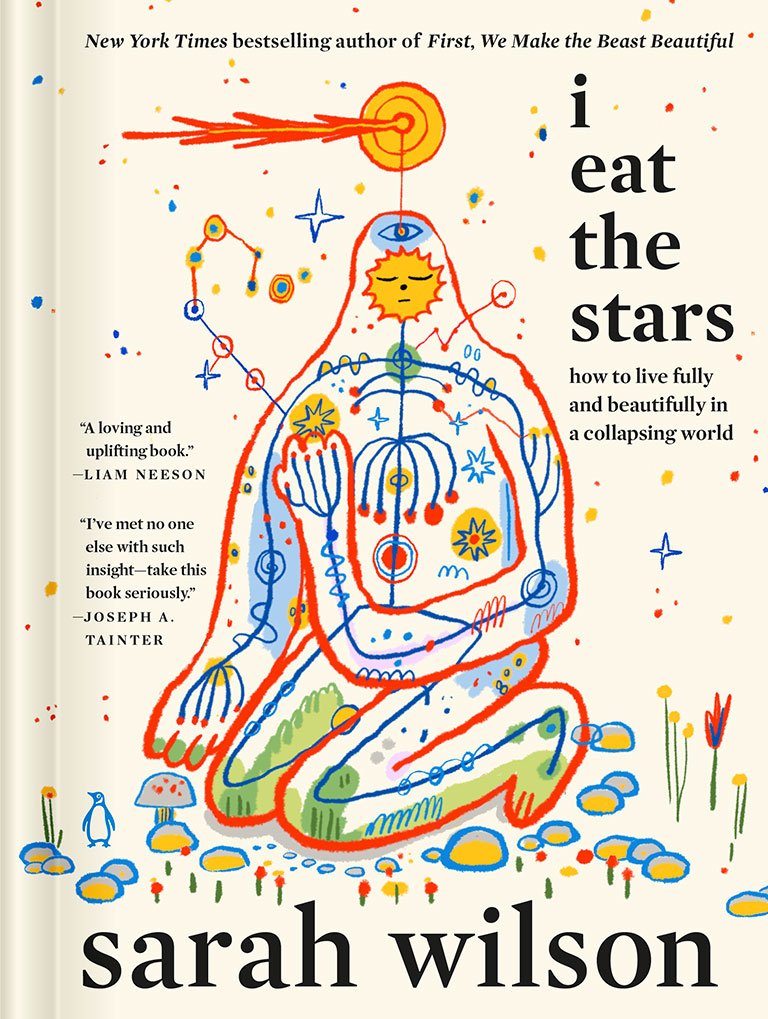
Feeling a little stressed myself, a new book caught my attention, I Eat the Stars How To Live Fully and Beautifully in a Collapsing World by Sarah Wilson. The title is strange but she explains that it is line from a poem by Rebecca Elson that starts “Sometimes as an antidote to fear and death, I eat the stars.” The collapsing world part of the title hit home. I don’t see the climate getting better in spite of new techniques and technologies.
Neither does Wilson. I liked that she is considered a philosopher and has interviewed hundreds of experts and done research in fields related to collapse. As a result, she includes great quotes. She invites us to read the first 3 chapters and decide if we want to read the rest. Chapter 1, Hope, has a quote from Liam Neeson. “The growth-based comfortable existence is over.” Chapter 2, Relief, includes a story from James Stockdale, who survived being held prisoner by the North Vietnamese. He relates that the other prisoners who relied on hope of release “died of a broken heart.” Chapter 3, Truth, concludes that making sense is more important than turning out like we wanted. Wilson advises us that giving up hope of maintaining the status quo leads to relief. Count me in.
Then she bears down on collapse with a quote from Ralph Waldo Emerson: “The end of the human race is that it will eventually die of civilization.” We are getting more of that end-of-the-human-race part with dire predictions about artificial intelligence lately. Wilson sees no way out of climate change and says AI will fail because it tries consume all of our water and energy. “The Titanic is going down and we’re debating the right way to fold the deck chairs.” Part of the problem is “our collective inability of pay attention.”
This year my attention has become attuned to centralization. Noting that despite all the hype about seeds from big companies, they are not necessarily better, I am doubting that any information from big companies is the unvarnished truth. They often offer solutions to problems we are familiar with such as diseases, poverty or poor crops. That is the situation where Wilson introduced me to a new word, moloch. Moloch is an ancient Canaanite deity associated with child sacrifice in the Bible. The term later evolved into a metaphor for any brutal force or system that demands terrible human costs. Wilson associates it with a cascade of events with outcomes the opposite of the intended one. A simple example would be people in the front row of a concert standing up, forcing everyone behind them to do the same. A more devastating one is the nuclear arms race where nuclear weapons developed by one country induce others to do the same or worse. Innumerable other examples follow the same trajectory such as more powerful AI or research into bioweapons or pesticides that insects inevitably evolve resistance to.
A common moloch thread is the rise of authorities promising solutions to problems but demanding the loss of freedom or representation in return. When the situation gets bad, she writes “There are of course god-awful opportunists out there doing the work of vultures – investment firms, Big Tech, Big Pharma, Big Ag, Big Oil, the broligarchy…” Wilson cites Clay Shirky: “Institutions will try to preserve the problems to which they are the solution. That’s what they do.” (For instance, I see money going into cancer research for a cure but very little going into prevention.)
The crisis Wilson addresses reinforce each other. Climate change makes financial insecurity and inequality worse. Inequality fosters war. War makes diesel fuel more expensive. Transportation costs make food and everything else more expensive etc. We have seen the “hockey stick” picture of the increased effects of global warming. Wilson paints all of these as having their own hockey stick graphs. Anything that seems to be slipping will only get worse and do so much faster as time goes on.
Sarah Wilson and I agree that this is not necessarily a picture of unavoidable doom. It is a picture instead of unsustainable growth in the face of natural laws. She first quotes Kenneth Boulding. “Anyone who believes in indefinite growth in anything physical in a physically finite planet is either mad or an economist.” Then Wilson quotes Gaya Herrington on why economists are so keen on growth. “Growth is the only way poverty can be eliminated without the rich having to give up something.”
What everyone has to give up on is complexity. Her studies show that complexity causes civilizations to collapse. Any disruption in the supply chain, people’s health, or a million other things can trigger a tipping point to collapse. She advocates that we start making our lives simpler right now by working with nature. Nature will force us to live more simply one way or another. People I have interviewed who lived through the “Great Depression” recount moving to cities to find work but returning because the countryside has steady work and healthy food. We have a head start on simplicity.
There is more to this than living simply. No one person has all the answers but we all want to survive and have something to contribute. Wilson says we can start to find those ideas using the 3 C’s, collaboration, cooperation and communication. There are more ideas in this book than will fit in one article much like the abundant seeds that nature gives us. As David Fleming wrote, Sarah Wilson asks us to “draw inspiration that has lain dormant, like the seed beneath the snow.”
Exceptional…. Thank You Joe!
Permalink