
I was driving south on Highway 25 toward Gifford. Spokane Public Radio was broadcasting an interview with a child psychologist about children’s declining mental health in America. He admitted that there are issues with too much time on computer and cell phone screens. But the biggest cause of anxiety and depression he sees is the more recent decline in play time outdoors with other kids. Thinking about all the time my brothers and I spent playing in woods behind our house as a kid, I had to admit that things have changed.
I was on my way to visit friends at a monthly crafting get-together. Along the way I passed the Quillasascut Farm School where Rick and Lora Lea Misterly have been living the Slow Life, growing Quillisascut Farm™. They started out with a bare piece of ground; gradually over time building a home, a farmstead, a cheese business and a school to share their love for all things farm to table. (https://quillisascut.com/) They also host gatherings of Slow Food Upper Columbia (https://slowfooduppercolumbia.wordpress.com/) where we share great homemade and homegrown food and discuss gardening and other skills for country living.
I passed near the Strager Creek Grange in Gifford where the Huckleberry Range Community Collective (HRCC) swaps seeds and plants in the Spring. They also share equipment and pass along contacts and information on a host of topics having to do with growing food, farming and getting along. They recently hosted a fundraiser for folks who lost homes in the Bradeen Fire. (We were both in evacuation zones for that fire but at different levels.) The Grange itself has a long history of standing up for the needs of rural folks. (https://www.facebook.com/groups/huckleberryrangecommunitycollective.org)
Even further south the Uhuru Community hosted the Inland Northwest Permaculture Convergence with topics like Companion Planting, Mushrooms & Mycelial Networks and Worms and Vermiculture.
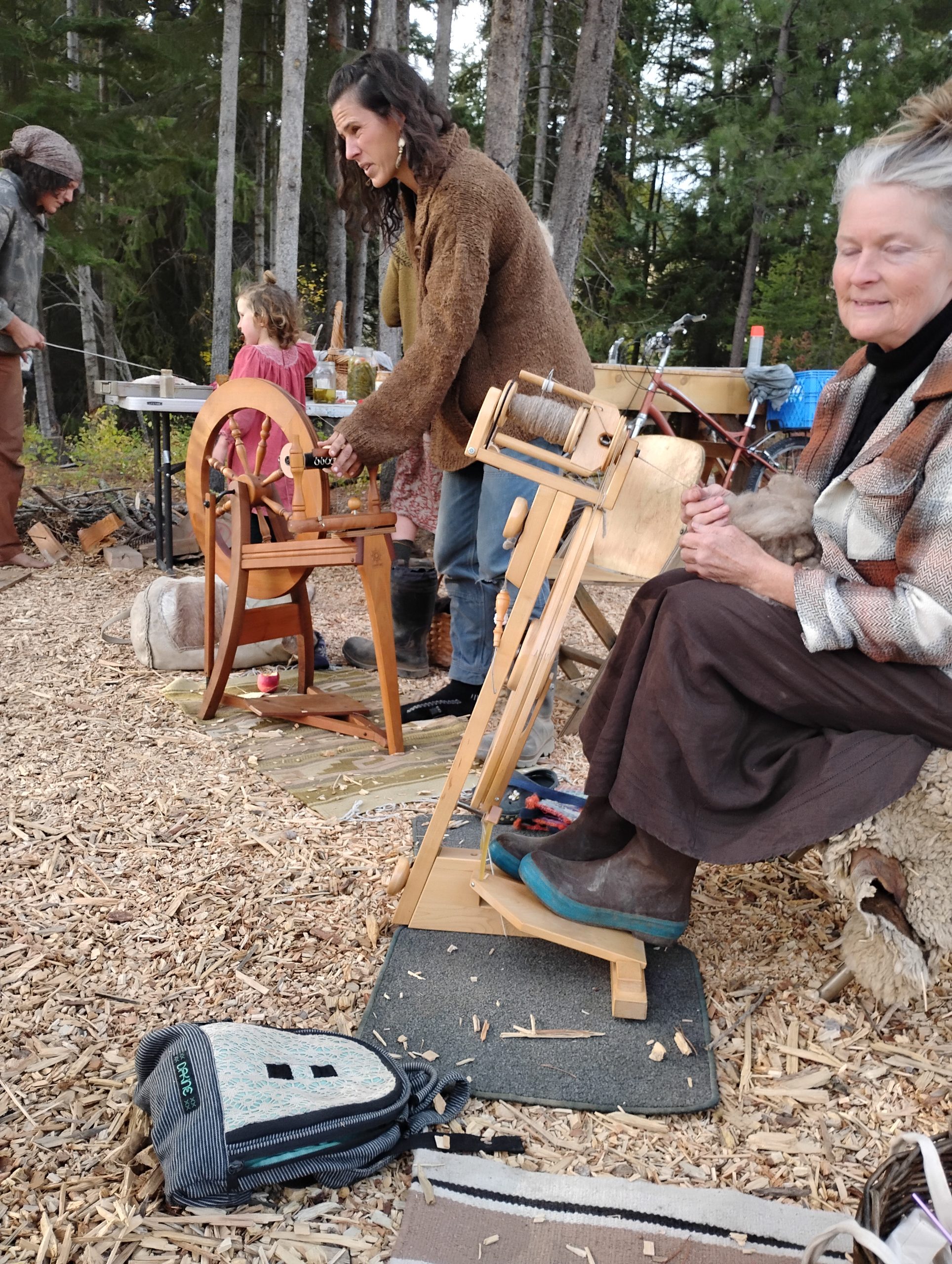
Finally arriving at my friends get-together I joined a group of crafters all working on different things to do with wool and fiber arts. There were some people spinning wool with spinning wheels of different kinds, one was carding wool to line up the strands, another was felting to make some slippers. Talking with each one I learned new things and maybe more importantly, that there are many more things to learn.
I watched as an assortment of children ran around playing, asking questions of the crafters, roasting apples for themselves and probably learning more than I was. Thinking back on the psychologist recommending that children learn and live best when given time to play outdoors, I could see his ideas in action. It was not just kids playing by themselves, but they were interacting with adults. I can’t think of a time in my childhood being raised in a nuclear family where so many adults and so much learning was going on. Also, it was not an authoritarian classroom-like situation, the children were learning by watching and asking questions on activities they were curious about.
Many of the crafts that these pastural folks practice arise from the necessity of doing the most with a herd of sheep. They preserve and eat lamb, make really tasty sheep cheese, tan hides and sew their own clothes. Humans have survived in close association with animals for thousands of years. Although many of the skills were new to me, they are about as direct and straight forward as you can get.
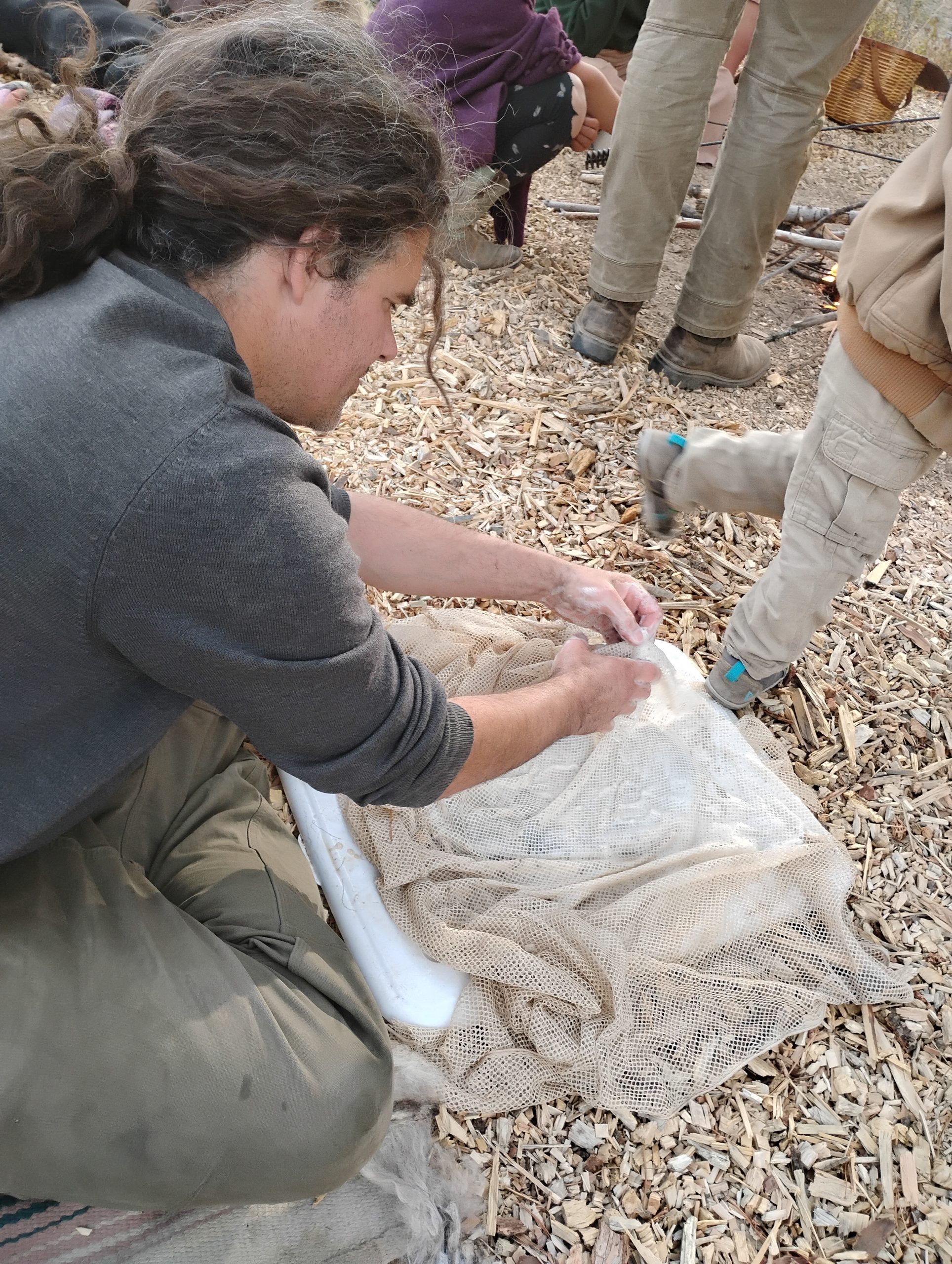
Many similar “primitive” skills can be learned at the Between the Rivers Gathering in Valley Washington. (https://www.betweentheriversgathering.com/) The annual Gathering has been poplar and productive for our lands between the Pend Oreille and Columbia Rivers for many years. It teaches skills like: Atl Atl and Dart, Archery & Bow making, Basketry, Blacksmithing, Buckskin Tanning, Campcraft, Clothing & Decoration, Fibers, Cordage & Weaving, Friction Fire, Flintknapping, Footwear, Fur Brain Tanning, Hunting, Tracking & Trapping, Stone Tools, Navigation, Pottery, Shelters, Survival Skills, Tin Smithing, Tracking, Water Craft, Weapons, Wild Edibles & Medicinals, Woodworking, and Much More! The interest in these ancient ways of life stands in sharp contrast to the mechanized and computerized world most of us live in.
In last month’s NC Monthly, I wrote about the impending collapse of much of what we consider as normal today. The way forward prescribed by Sarah Wilson in her book, I Eat the Stars, is collaboration, cooperation and communication. These communities do that in both their life style and their dedication to helping others learn to live more simply and directly. I can’t say that this will be easy living. There is a lot of work involved, but it is sustainable and healthy work.
There are advantages and disadvantages to living close to your friends. When you can trust to leave your children with each other, to help each other build homes and cultivate gardens, life is less expensive and often more fun. There can be long meetings and legal questions, feuds and failures in any community. This is not a path for everyone. Large families, civic and religious groups and just plain neighbors all support each other when the going gets tough. Our resilience here in Northeast Washington gives us a leg up on surviving and thriving in harmony with the earth.