Barreca Vineyards

Barreca Vineyards

From Vine to Wine since 1986

Wine 2015

Vines under the Elm tree

Vines under the Elm tree

So much has happened and is happening with the winery that it is hard to know where to start. I’m scheduled to give a talk on growing grapes organically at the Tilth Conference in Spokane this November.  So I think about that while I am out picking grapes or some other task in the vineyard or winery. I’ve been making wine for 40 years and growing grapes for 28. A lot of what I have learned is by making mistakes. That may not be the most welcome message for a conference on growing organically but it’s honest. In keeping with that tradition, I made a few more this year and have some “experiments’ in the works that may also turn out that way. But basically I am bringing in another crop that should earn some money in two or three years when the wine is ready.  The grape starts look happy in their pots in partial shade.

Dedicated readers may remember the video in the first part of the blog on “Critters”.  It shows a swarm of white flies over our apple tree. Leaf hoppers have traditionally been the problem bug in the vineyard, so I wasn’t ready for this year’s invasion of white flies. It is probably another result of a warmer climate, certainly a warm winter and dry summer. It took awhile for me to realize that I needed to spray Neem Oil to control the flies and I lost a lot of healthy leaves before I did.

Gewurztraminer nearly on the ground

Gewurztraminer nearly on the ground

I did realize that I needed to water steadily since it has not rained significantly all summer. Our well held up as I had a travelling sprinkler going almost every day all day in the vineyard. The vines responded with a heavy crop that kept pulling the canes down till they were in the range of the sprinkler (not a good thing). I kept tying them back up but next spring I really need to revise my whole trellis system.

Word got out that I am willing to recycle wine bottles by washing, inspecting and sterilizing them. Now my supply of used wine bottles has far outstripped my capacity to keep them organized. I’m actually sorting out cases of bottles by the winery they came from so that I am using identical bottles for each of the batches of wine. I’m sure that I have well over 1000 bottles that still need sorting out.

It was a good year for cherries, but a bad year for bears. As noted in the “Critters” blog, we had to chase one away from our cherry tree. Later we had to chase it away from the whole garden. At least I have not had to sleep in the orchard like our neighbor, Jeff Herman. There were so many cherries that John Crandall at Riverview Orchard could not sell all the organic cherries he had. So He gave me 400 pounds that I crushed and am making into wine. To make that work without adding sugar, I borrowed a gas burner, commonly used to deep fry turkeys, from my son-in-law Tony Houston and cooked down part of the juice to boost the sugar to where I wanted it.

By the middle of the summer it became obvious that I would not have enough carboys this fall to handle the new crop of grapes. I found a small winery in Euphrata that was going out of business and bought a van load of carboys plus a lot of other equipment and supplies from them. They barely fit into our Volkswagon Vanagen but I’m going to need almost every one. What is not so obvious is where all these will go by the time I have them full of wine.

Nets on Grapes

Nets on Grapes

A wet Warbler

A wet Warbler

I was determined to get nets that would not snare so many birds this year, which I did. But it took a lot of work to measure and cut them and to shorten a lot of my trellises to make them fit. By the time I had somewhat finished, the birds were on to the fact that the grapes were ripe a month ahead of schedule. But I was not on to the fact that they would be eating varieties of grapes that were never ripe enough for them to be interested in in years past. New nets arrived on August 4th. On August 30th I exported a record 10 birds that I caught in the nets. One trick I learned was that if you soaked the birds with a garden hose while they were in the nets, they were much less likely to get away from you when you lift the nets. The birds were not too happy about that, but at least they lived. During the fires, there were not many safe places to be a migrating bird.

On August 5th Cheryl and I put up a new canopy and sold wine at the Northeast Washington Farmer’s Market. We can’t do tastings there, but that might be a good thing. We don’t end up with any open bottles to finish off ourselves. We have also been selling fresh grapes and some map books. The market has been a whole new social experience for us as

First Day at the Farmer's Market

First Day at the Farmer’s Market

well as an economic one. Our inventory changes slowly as we sell out of one batch of wine and have to bottle and label another one. With most of our inventory in 5 and 7 gallon carboys, each one seems to take on a unique flavor profile of its own, which we try to describe to our customers.

Grappa from Dominion Distillery

Grappa from Dominion Distillery

In another new twist for us, we brought some of the left over mash (skins and seeds with the wine drained out but not pressed out) from making wine to Henry Anderson at Dominion Distillery in Colville. He made Grappa, an Italian wine liquor, out of it. It is very smooth and tasty. We plan to do more of that.

We have been harvesting and making wine for a month now. Birds did a lot of damage but they did not wipe out the whole crop, as they did in several of the backyard vineyards around us. Just as damaging but mostly unseen, were raccoons. Someone hit and killed two young ones and left them at the foot of our driveway on August 13th. At the end of September our dog treed one near the same spot and I caught the bright reflection from my flashlight of two yellow eyes 30 feet up in a pine tree. I could see where they had gone down the rows under the nets picking the low-hanging fruit furthest

Grapes gone to the wildlife

Grapes gone to the wildlife

away from places I usually walk. Once in awhile they would climb into the vines and snag every grape within reach.

With the grapes ripening early and some people who said they would help pick not showing up, a lot of grapes are getting sweeter than ever before. One friend, Kit Shultz, did help but his wife’s cancer diagnosis but them on a 90 day chemotherapy regime a couple days later. For many years now, getting the grapes sweet enough before frost was the challenge. This year, even my “global warming” grapes are getting too ripe. This makes it harder to produce dry wine, which the Market is showing us many people prefer. I’m hoping to balance that out with yeast that converts more sugar into alcohol, making a dryer but stronger wine. In a few years we’ll find out if that works, or if I am making another mistake. In farming, like warfare, you only seem to be equiped to fight last year’s battles.

Fires 2015

Colville Fire July 3rd

Colville Fire July 3rd

We knew it was hotter and drier than ever early in the Spring. Luckily our water never gave out – though it sputtered if we had 3 sprinklers going at once. I was watering the grapes every day and Cheryl was watering the house, yard and grounds most days. On July 3rd I was going to Colville to shop and there was a thick column of smoke streaming up a mountainside a mile or so from town. I took some pictures. By the time I was returning, a plane and some helicopters were on it. It was controlled in one day but stood as a stark reminder that the next day, the 4th of July, was not a good day to set off fireworks. We were afraid some fool would do that near us on Lake Roosevelt. But no one did. It was the quietest 4th of July ever. Even the fireworks show scheduled in Colville itself was called off.

Three weeks later, I was returning from a trip to Ephrata with a van full of wine making equipment when I saw another column of smoke 10 miles south of us on the Addy-Gifford road. There were already planes scooping water out of Lake Roosevelt and attacking the fire. Again the fire did not spread far before being stopped but destroyed structures and shut down the Addy-Gifford Road.

Stickpin Fire

Stickpin Fire

But fires had started in earnest on Lake Chelan and in Okanogan County West of us. And on Boulder Pass between our home and our daughter, Aprils’ near Curlew. By August 2nd we were breathing their smoke. As those fires grew, the weather became unsettled. On August 11th, lightning from thunder storms in the Kettle Range created the Stickpin Fire. Soon that one was joined by the Graves Mountain and Renner fires to create the Kettle Complex, which grew to 73,392 acres. It is now contained but still smoking.

NorthStar and Tunk Fires

NorthStar and Tunk Fires

2 days later the human-caused North Star Fire started on the Colville Indian Reservation a little over 30 miles southwest of us. It grew to 218,138 acres and threatened to burn the town of Republic, County Seat of Ferry County. Nearby the Tunk Mountain Fire took off, and eventually burned 165,918 acres almost joining the North Star fire.

Carpenter Road Fire

Carpenter Road Fire

The next day, August 14th, the Carpenter Road fire, another human-caused fire started on the Spokane Indian Reservation, 30 miles directly south of us. Another fire started on Gold Mt, 12 miles north of us and knocked out power to the town of Kettle Falls. It also burned an outbuilding of our friend Amy Kegel. They called in firefighters from Montana and gave them a police escort to come here and fight it, because all of the local resources were on other fires already.

Smokey Sunsets

Smokey Sunsets

The valleys filled with smoke, the ghosts of dead forests from the mountains around us. We wore breathing masks outside. Ash rained down on buildings, cars, the garden… Fire camps sprung up in Colville and Kettle Falls. You would see helicopters and planes flying here and there to fight the fires. Cheryl’s cousin Kathy had to evacuate to avoid the Carpenter Road Fire. She then lived with her sister, Pat, in Chewelah for weeks. Cheryl met our mailman at the laundromat. He and his wife had to evacuate their home on Deadman Creek in the path of the Kettle Complex. Their place was saved but fire came right to the edge of their field.

By August 21st, we were preparing for evacuation ourselves. We stacked up our most valuable possessions ready to load them into vehicles and head for a wide-open paved area nearby. I helped the local fire district print cards with the 6 “P”s, People and Pets; Papers (phone numbers and documents); Prescriptions; Pictures and memorabilia; Personal Computers and drives; Plastic credit cards and cash. Fire Districts in all directions were asking for more map books, and my printers were broken (see breakdowns blog when it’s written).

Chinook Helicopter

Chinook Helicopter – You can’t see across the lake.

On August 27th we heard a giant two-rotor Chinook helicopter come through the smoke and hover for a long time over the little bay on the lake near us. We thought a new fire must have started nearby. The smoke was so thick you could not see across the Lake. I drove down and took some pictures. In the end I think they just flew out from the helicopter base over the hill in Colville, and headed for the closest water so they could practice using the bucket.

Everyone was jumpy. We cleared the pine needles from around our buildings that had built up there for years. We checked the Incident report and a facebook page on local fires several times a day to keep up with the action. Signs appeared in businesses and driveways everywhere thanking the firefighters. Evacuation shelters sprung up in many high schools and even some of them had to be evacuated themselves. Some friends of ours lost their homes. But we all chipped in to help with food, clothing etc. The fire fighting centers had to start refusing any more food and supplies. Communities from Western Washington sent semi-trucks loaded with provisions. The county set up an emergency communication center in the courthouse.

Thank You Firefighters

Thank You Firefighters

On August 30th there was light rain without thunder storms. The smoke cleared. It did not go away entirely. You could smell it in the still of the morning. But essentially it was over. The big fires will smolder in their centers until snowfall. We could still have more, but the days are cooler and the air is clear. We can literally breath a little easier and hope we never see a summer like this again, and plan to be more prepared if we do.

Underground House Part 3

Clarence's  Oliver crawler saves the day

Clarence’s Oliver crawler saves the day

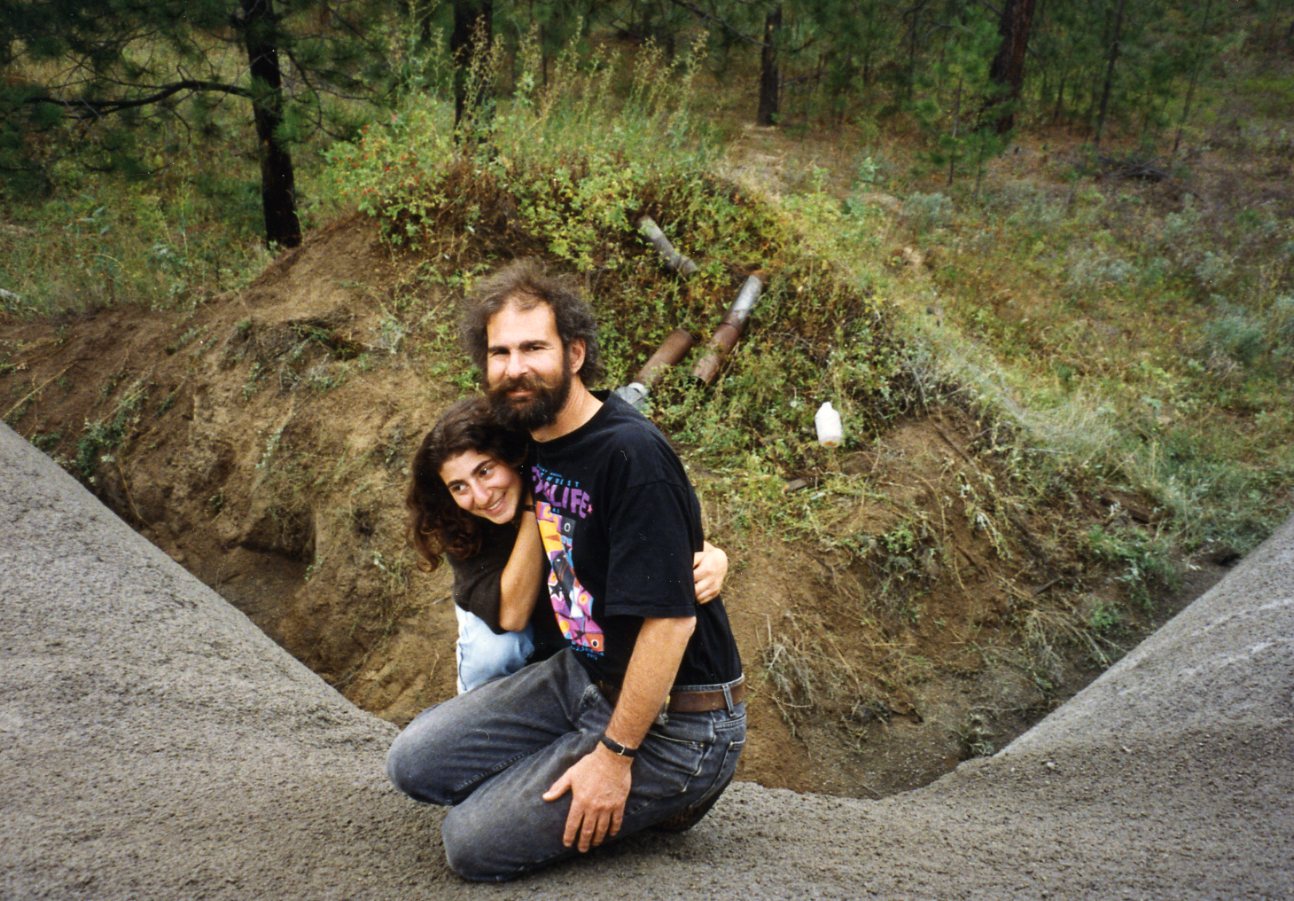
Here we are on month three of the story and year three of the actual building of our underground house. With the tile and rocks in place at the end of 1992, I needed to get the rebar skeleton in position for shooting the concrete onto the forms. A lot of decisions had already been made to get this far. Cheryl and I had looked at buildings near Coeur D’Alene made by shooting concrete onto inflatable forms. The result seemed too uneven for our purposes, but the way they accomplished it was to have woven chicken wire over the inflated forms and shoot a thin 1″ coating of concrete onto that. After letting it set up overnight, they could cover it with several inches of concrete and not have it collapse under the weight.

Originally we were expecting to borrow some forms used on a couple of other similar structures. They had extensive trusses built into them to support the 76 tons of wet concrete we expected to use on the house. The crane truck used to move those forms however broke down and we were not able to get them. I wanted to have insulated forms so we could use the inside space over two winters while working on the outside. We could get by with these lighter forms by shooting one thin layer of concrete, letting it set up and then coming back with the full coat the next day.

Bob Cunningham loves his work.

Bob Cunningham loves his work.

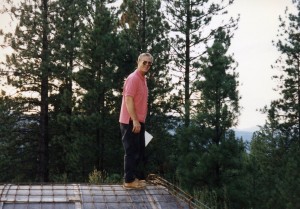
Although my concrete guru, C.R. Conn, let me use engineering diagrams from Washington State University showing immense strength in 3″ of concrete over 18 foot diameter roman arches, the building department was not satisfied and wanted a signed engineered document for the whole house before they would grant a building permit. So I found a local engineer who would take on the project, Bob Cunningham. This was the early 1990’s and although Bob was a good engineer, he had never used a spreadsheet for mathematical calculations. We worked out an arrangement where he would come to the Assessor’s Office after hours (where I worked as a programmer) with his mathematical formulas. Together we put them into a spreadsheet. It worked great and we assembled some amazing graphs and tables.

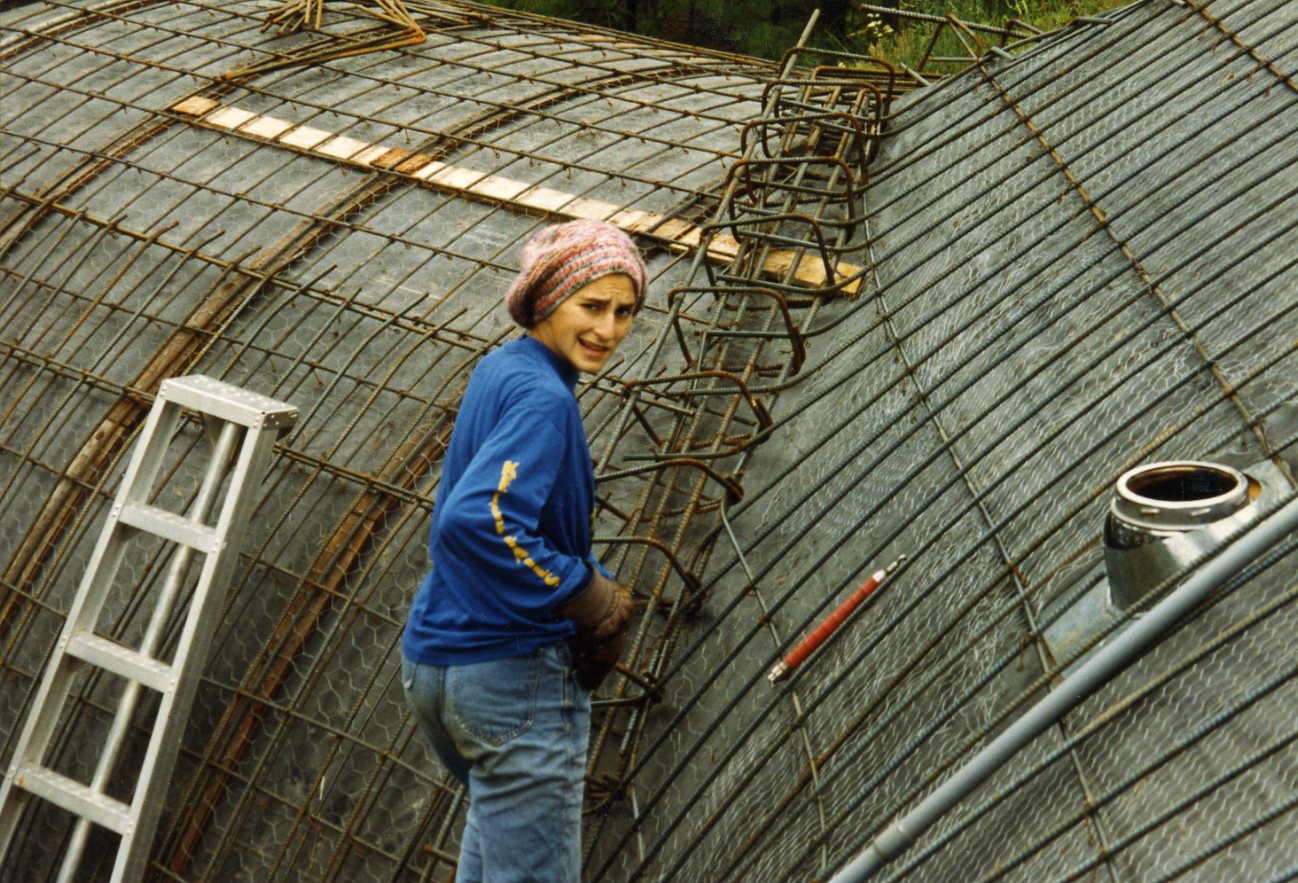
April on the job.

April on the job.

There was one hiccup. After doing all the calculations, Bob asked me where I thought it would break if it did. I thought that the joints between the central dome and the side arches could develop cracks if the support under the arches was uneven. I thought Bob would pencil in some extra pieces of rebar across those joints and be done with it. Well it ended up with a lot more than that. He specified bent rebar collars every foot or so with heavy rebar going through the collars and along the joint, the opposite direction from where I expected the stress to come from. It doubled the cost of the rebar and was in the plans before I could say anything else. Oh well. At least we got the permit.

The design called for a double wall of rebar. This ended up being a lot of rebar, 3 miles worth. The steel truck that brought it up from Spokane could not turn around in our driveway. So he dumped it down at the bottom of the drive and left it there. Luckily, our neighbor, Clarence Tieszen, had a little Oliver tractor with tracks and a front end loader that he loved to use. He carried all that steel up to the house site for free.

HouseBuilding024

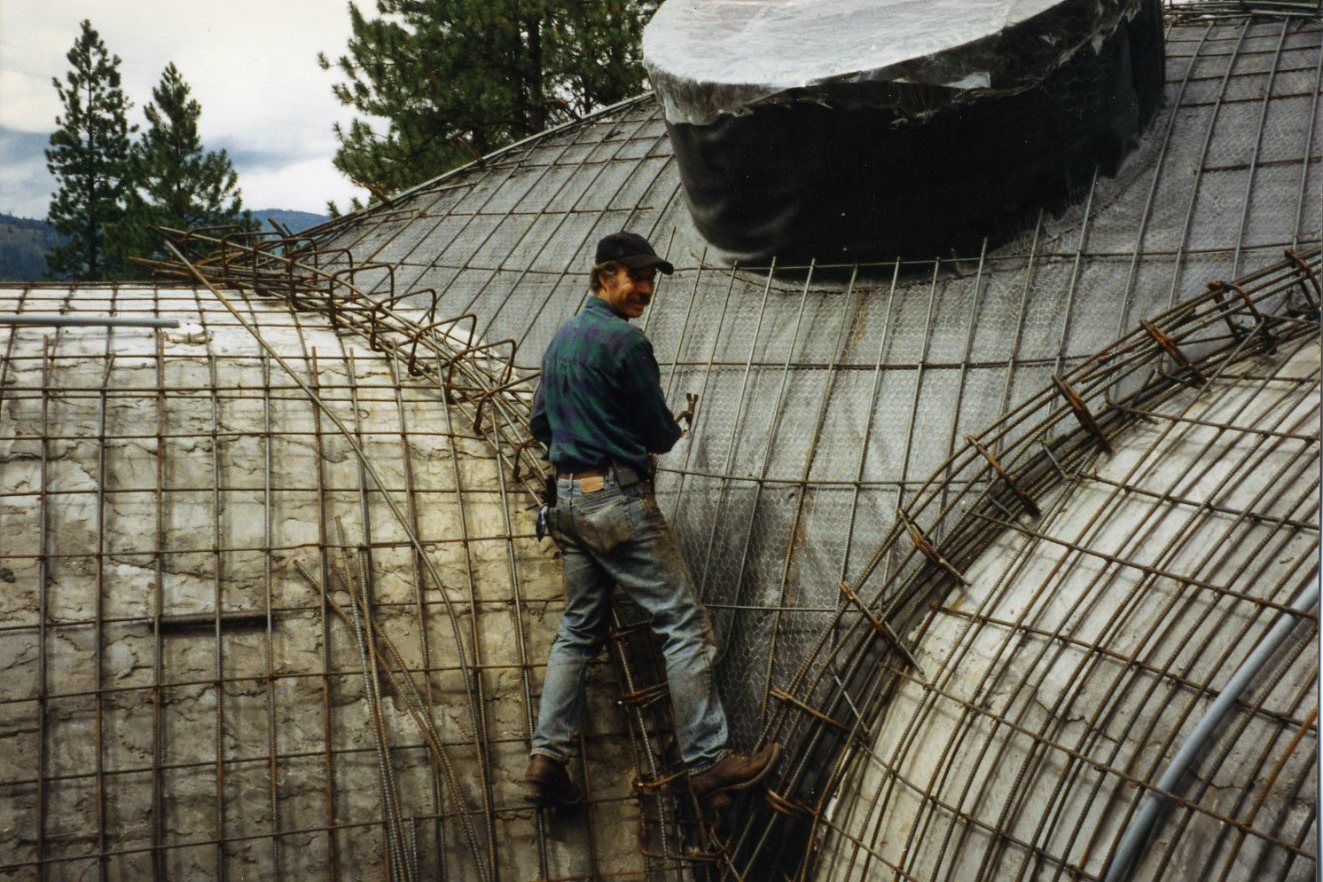
Jeff Herman tying wire

I was working 10 hour shifts 4 days a week at the office to have time to build the house the other 3 days at home. I dipped into the child labor pool again and soon Bina and April were cutting and bending rebar with an acetylin torch and tying wire with a twisting tool. I hired some friends and neighbors too, when they could get away. After a long summer of cutting, bending and tying rebar, we were ready for the concrete shoot.

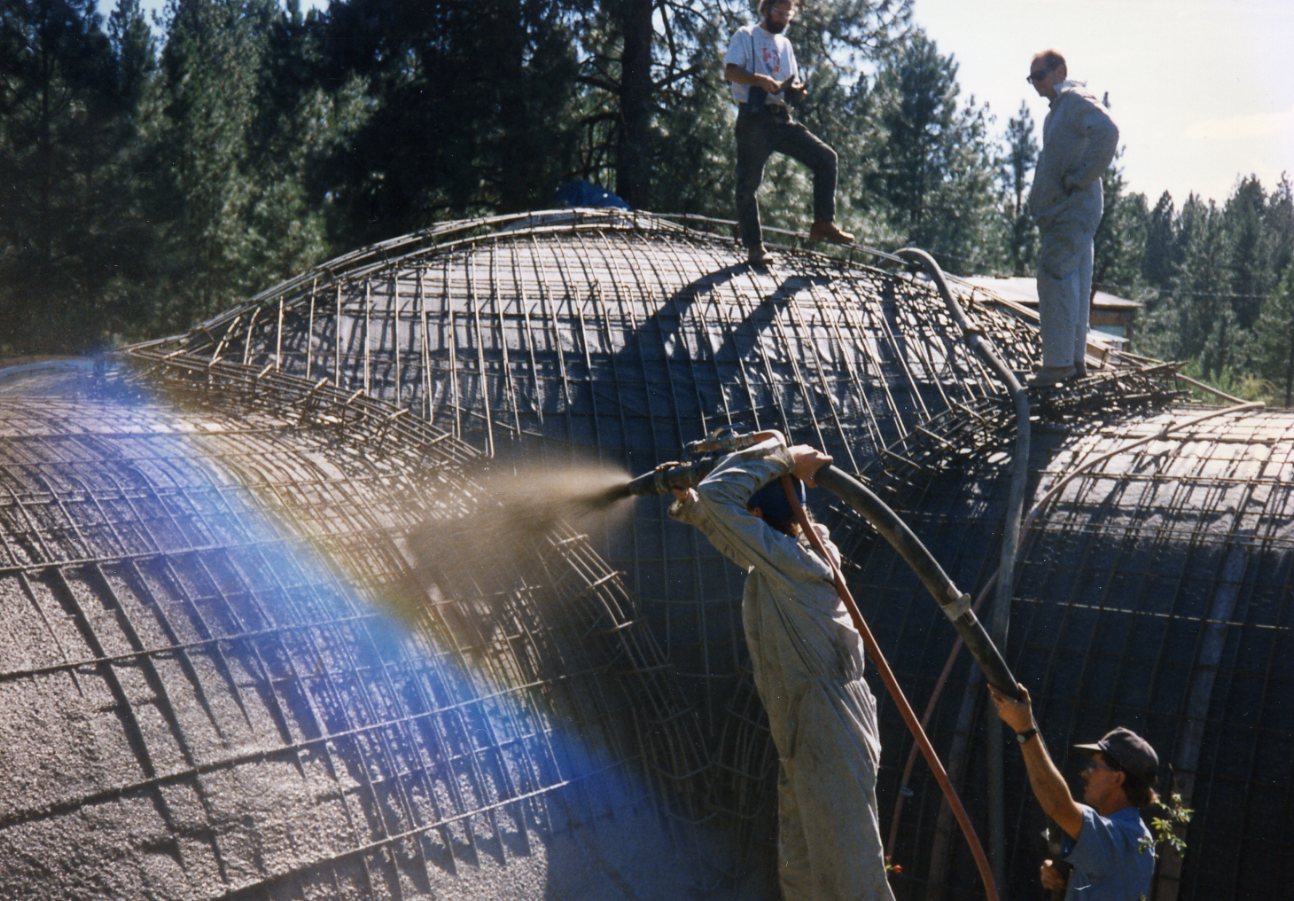
The  concrete rainbow

The concrete rainbow

There are two approaches to this job, gunite and shotcrete. Gunite is made with dry ingredients with water added at the nozzle. It is strong with very little waste but the materials need to be stored on site. We opted to use shotcrete. A series of concrete trucks bring in the wet mix. It is pumped through big hoses and compressed air is added at the nozzle to spray it on the structure. It takes special equipment, a big crew, custom concrete and coordination to make it all work. Throw in a bunch of curious family and neighbors and you have a really big show on your hands.

We did it

We did it

Finally that day came, or rather, those two days came. When the show was over, we had a really big hollow lump of concrete to live in. It had to cure for 90 days before we could bury it. But that doesn’t mean we couldn’t climb all over it and revel in the knowledge that it would be there for a really loooong loooong time.

Wine at the Farmer’s Market

Wine Selection for August 2015

Wine Selection for August 2015

Starting this Wednesday, August 5th, we will be selling our wine at the Farmer’s Market in Colville from 9:00 AM to 1:00 PM.  All of our wines are purely organic with no additives.

Left to Right and in the Reds, sweetest to driest

Golden Globe 2013:  Okanogan Riesling 2013 blend – A white semi-sweet wine with complex flavors
Lucie Kuhlmann 2013 – Sweet:  A medium red wine best for desserts or after dinner
Lucie Kuhlmann 2013 – Regular:  A semi-sweet red wine and the all-time best seller
French Rocks Red 2013: A house blend of Lucie Kuhlmann and Marechal Foch, semi-sweet with a long finish
Baco Noir 2013: A rich strong red wine with a clean aftertaste.
Leon Millot: An early-ripening medium red wine produced by Deep Roots Vineyards
Marechal Foch:  A deep red wine on the dry end of our spectrum.  Great with hearty meals.

Underground House Part 2

Starting the dome.

Starting the dome.

Cheryl helps raise the roof beams.

Cheryl helps raise the roof beams.

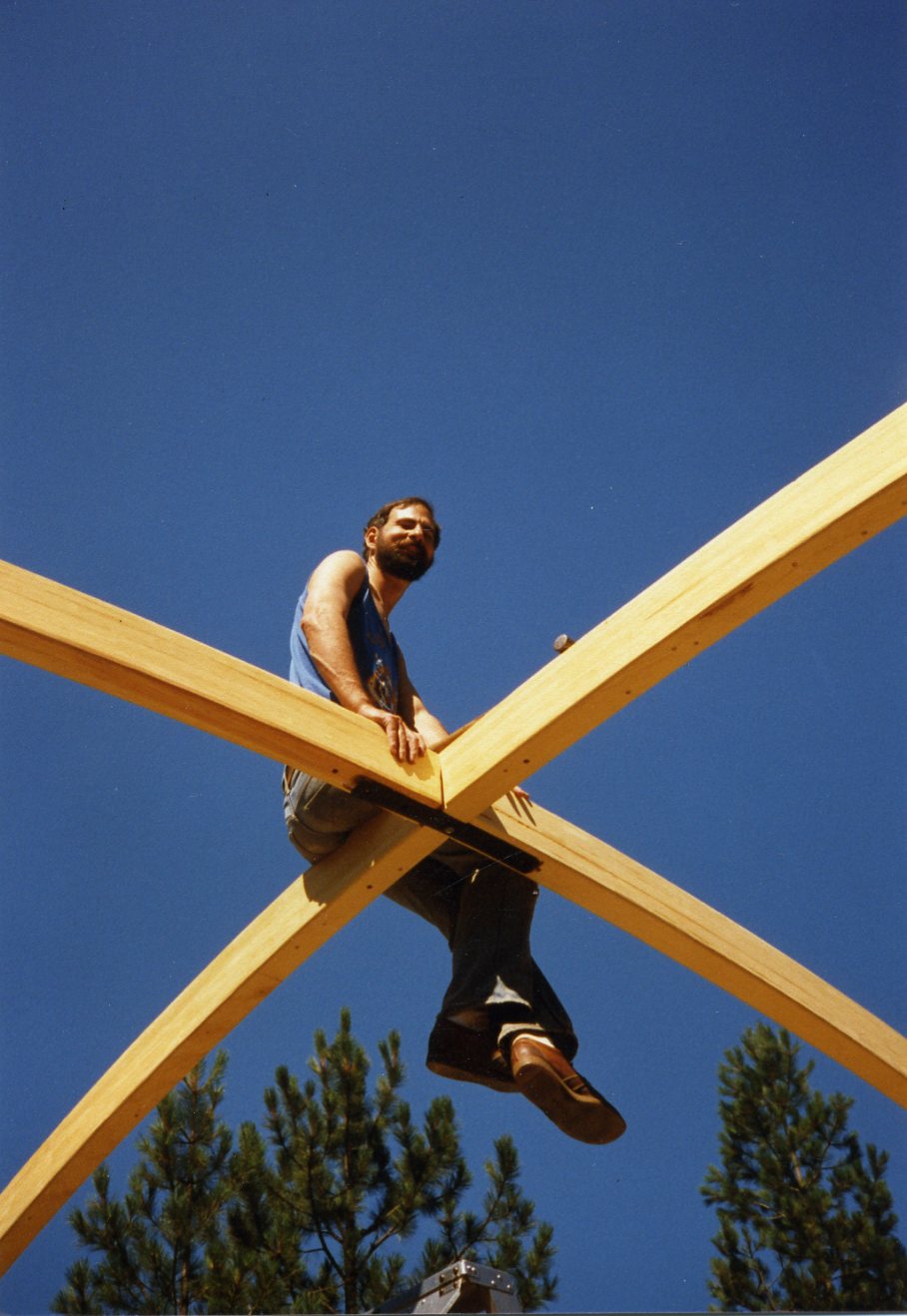
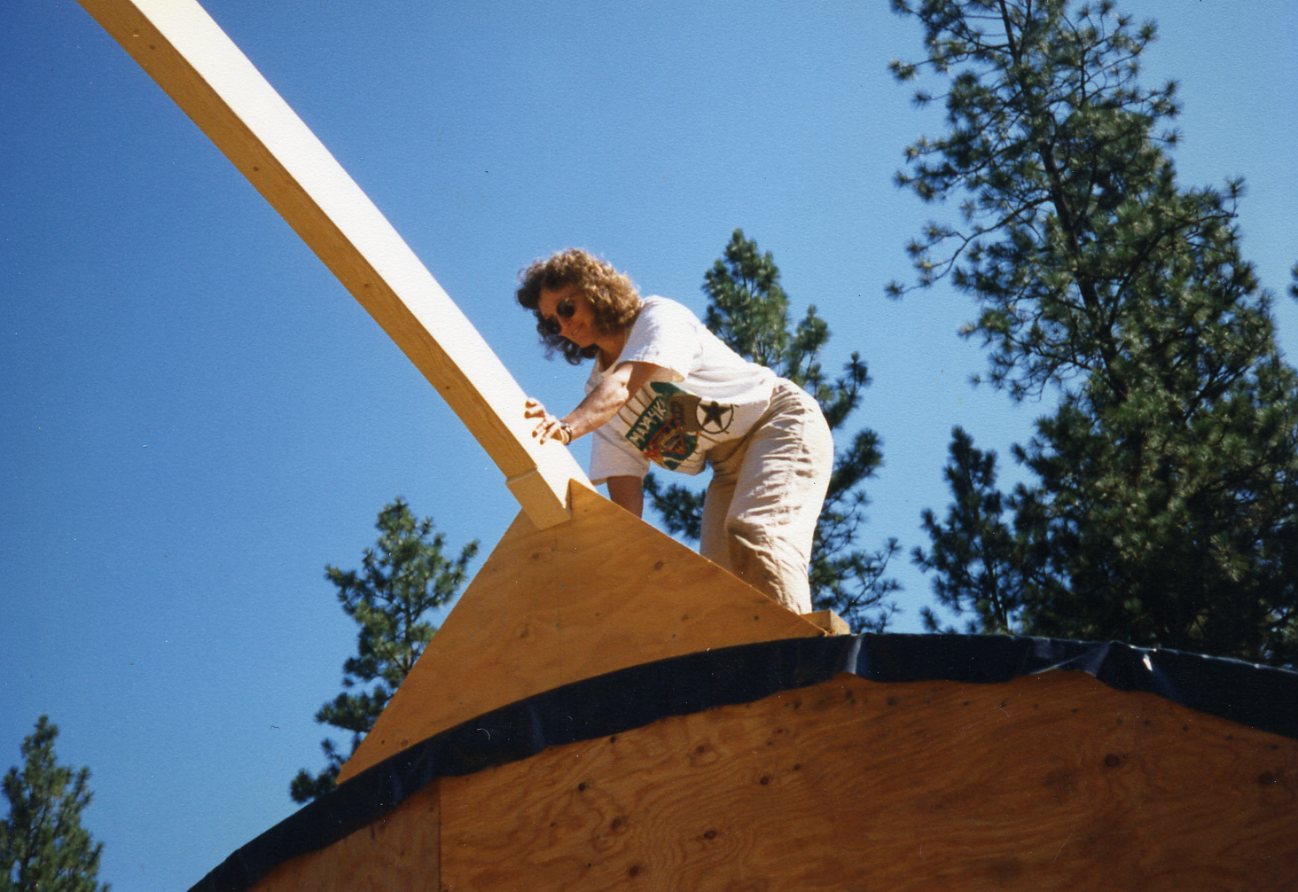
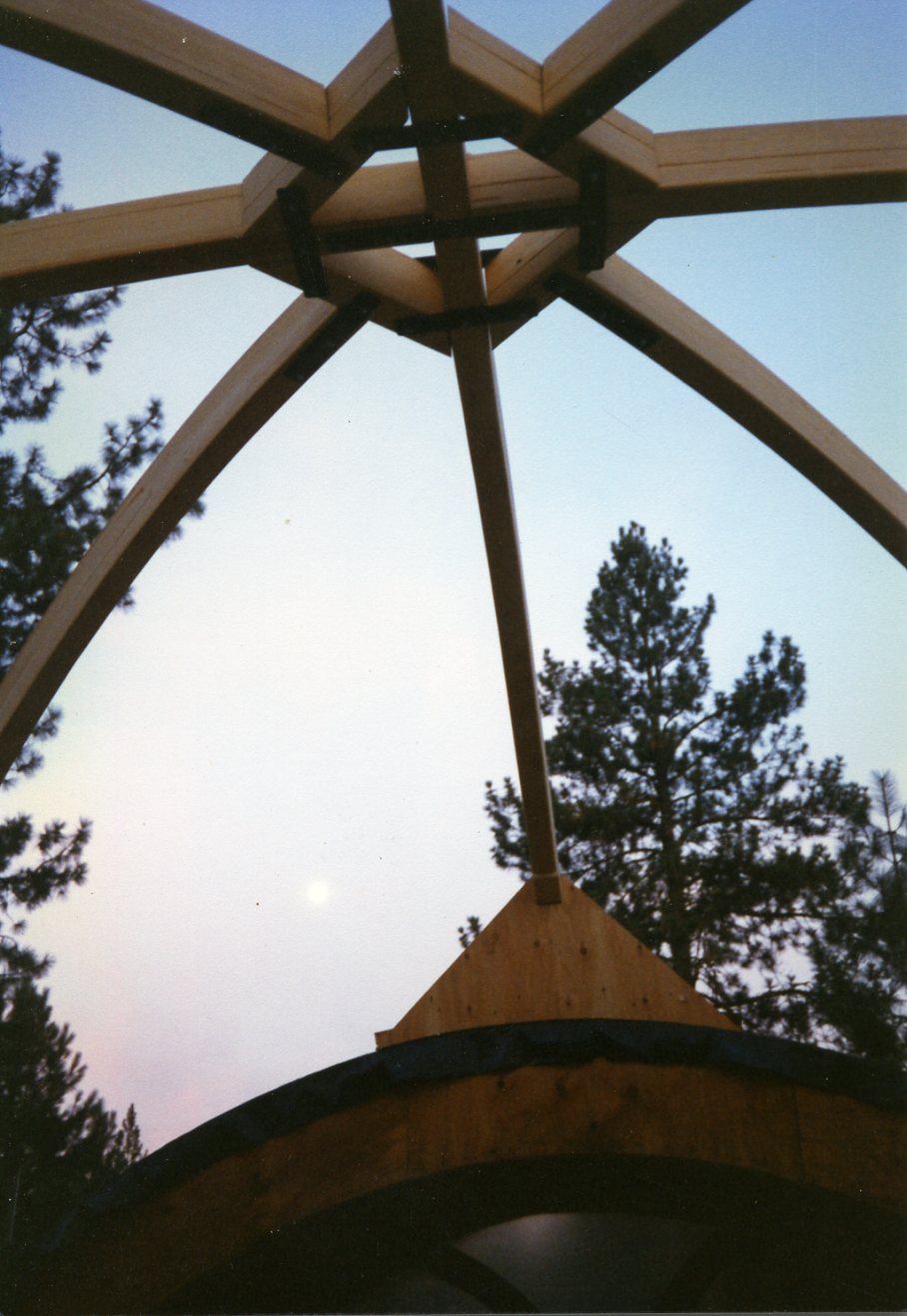
When we left off on the epic tale of building our underground house, we had gotten the main forms covered just in time to shed the snows of winter and with just enough space to build the curved laminated beams that would support the center dome. As spring emerged into the summer of 1992, the laminated beams emerged from the house/shop and came together as the structure for the central dome. Four of them came from the corners of the square floor of the central space and four came from the tops of the arches on the sides. They all met at a center yoke and were tied together with steel straps bolted through the beams. Believe me. I was one happy dude when all the math and construction proved to be spot on and the pieces fit together.


The whole set of beams

The whole set of beams

With the beams in place I sawed 2×6 tongue and groove pine decking to fit the curves of the arches and of the central dome. This was not simple since the cuts became increasingly long and angled in two directions. I ended up clamping most of them in the vice on my work bench and sawing them by hand. In retrospect, this was a bad idea altogether since it did not give me an easy way to finish the joints once the arch forms were removed. But I knew that I was my own guinea pig on this project and that is just the kind of lesson I wanted to learn. At the time I was thinking I might build more of these. As it turns out, people are unnaturally paranoid of living in underground buildings and this one is not ready to show off anyway. So no lessons have been applied elsewhere.

The hot tub on the roof.

The hot tub on the roof.

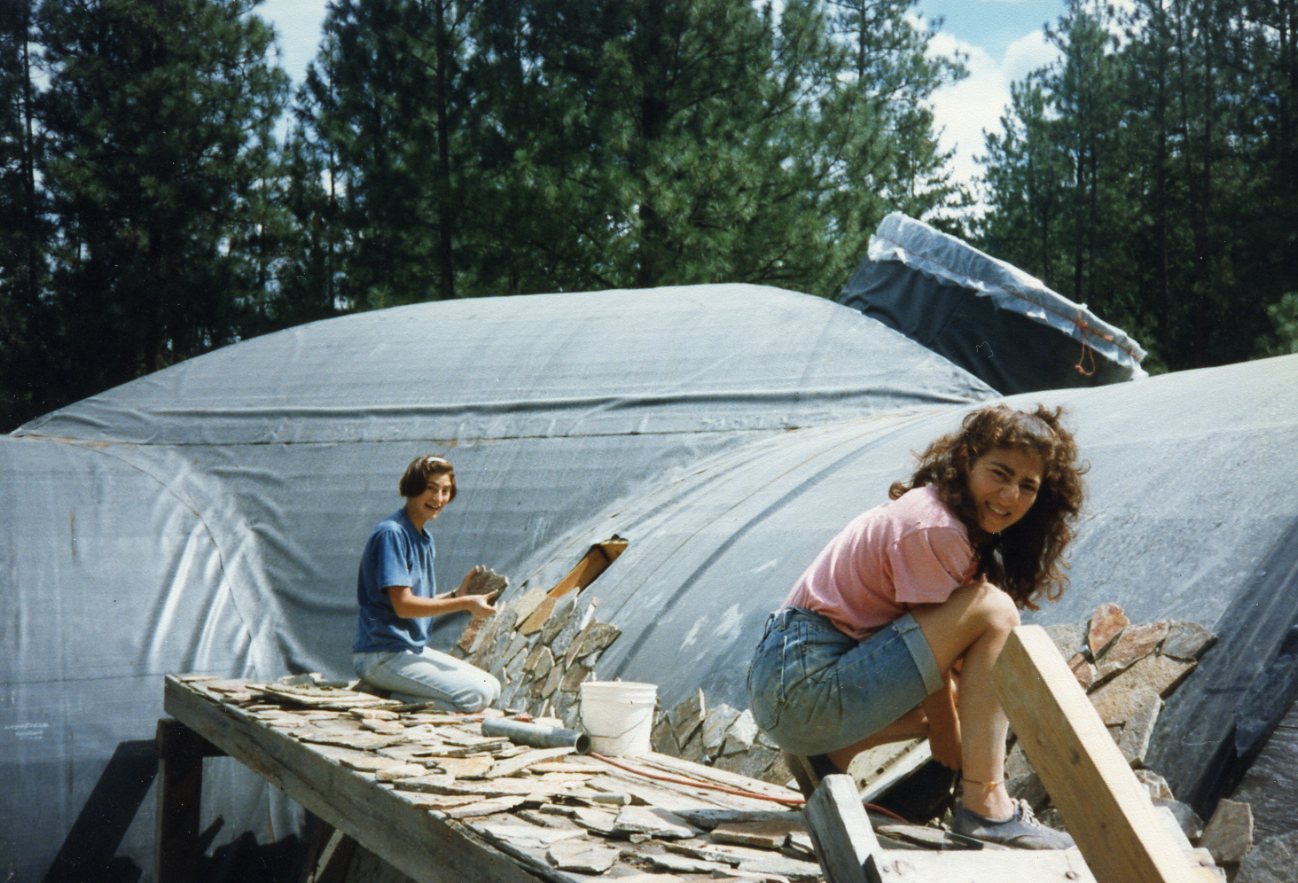
I knew that I wanted a skylight to bring light into the center of the house. It is a little more complicated when the house is buried in dirt. I built something that looks like a hot tub and placed it at a good angle to catch sunlight at this northern latitude. With the skylight and decking in place, we began to work on the interior of the arches from the outside of the forms. If that sounds weird, it is. I didn’t want raw concrete exposed on the inside of the house. The decking in the underside of the central dome would remain even after it was no longer structurally necessary. But I wanted rock on the inside of the kitchen and tile on the inside of the bathroom wing. Working on a tight budget, I used the cheapest alternative, child labor.

April and Bina laying rock

April and Bina laying rock

April, Bina and I went to Kifer Quarry and picked up hundreds of the thin (1/2″ or so) flat pieces of quartzite to cover the inside of the kitchen arch. Our plan was to put the rock in place on the outside of the form for the arch so that it would be inside the structural concrete when the form was removed. I wanted to hold the pieces in place with mortar, but didn’t want it wrapping around to the inside surface of the rocks. So the girls and I filled a little bit of the spaces between the rocks with clay, then covered them with mortar. This basically worked, when we removed the kitchen arch form (one year later), I was able to wash out the clay with a hose. But mortar is not strong enough to hold hard non-porous rocks really well, so we lost a few when the forms came out. Another lesson learned. (Quartzite is so hard that the Columbia River could not cut through the large deposit of it that forms the Kettle Falls.)

The layers of tile, thinset and mortar

The layers of tile, thinset and mortar

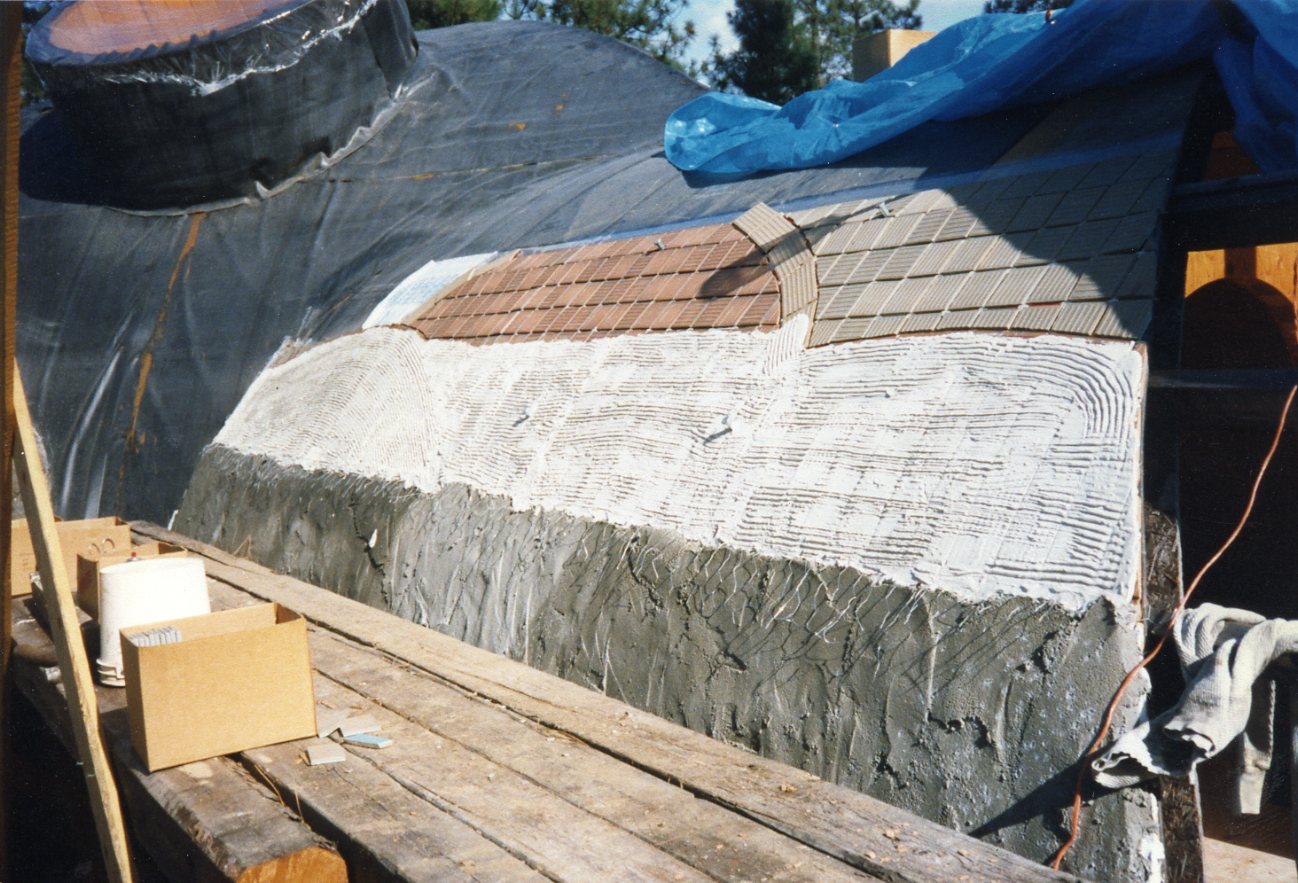
The answer to the what-holds-on-to-rocks question is thinset, the mixture you use to hold tile in place. (Too bad I didn’t realize that before we did the kitchen rocks.) The next big project was putting tile on the outside of the bathroom arch form facing in so that it would be properly exposed when the form was removed. To make life more interesting – or just because I’m nearly insane – I wanted to have the tilework form a pattern on the wall/ceiling of the bathroom arch. I worked out a design that looks like trees with curved hills in the background and a blue sky above. It was a little like those pictures you make with cut-out pieces of paper. I drew the pattern with a big yellow crayon on the rubber sheeting that covered the arch. To get the tiles to stay in place face down, I taped clear contact paper with the sticky side up to the rubber sheeting that covered the arch. Bina, April and I placed the tiles on the contact paper seperated by little plastic spacers, designed for that job, and with thin strips of cardboard between the tiles. I would later fill that space with grout from the inside but did not want to put the grout on from the back and have it wrap around the front of the tile.

The next year’s phase would be putting rebar in place over all of this tile and rock work. I wanted the tilework to stand up to the traffic a little better than I expected the rock work to hold up, so besides thinset on the back of the tile, I used a toothed trowel to carve furrows in the thinset that mortar could cling to. Between the thinset and the mortar we rolled out chicken wire to keep cracks from developing. The whole assembly was about an inch and a half thick. Granted, this was a lot of work but it worked out perfectly and was strong enough to walk on. No tiles were lost or too far out of place. Some of the form’s panels caused distortions in the pattern and the cardboard was tedious to remove. But we would not see that result for about another year.

So at the end of year two (three really if you count excavation and form work in 1990), we had a complete set of forms covered with rubber sheeting and over that sheeting on two of the four wings of the house, we had rockwork and tilework in place to be revealed when the forms were removed. We had a dry, heatable interior to the house but still did our cooking and socializing in the trailer.

Critters

Whitefly still picture click for movie

Whitefly still picture click for movie

I know, everyone wants to see the second installment of building the underground house. I’ll get to that. Meanwhile it has been a very hot month and there is a lot of buzz about that. I’m not going there either. The thing that struck me about June 2015 was the many encounters with critters that we don’t deal with every day. The first ones were small, but there were millions of them. Actually this picture and video were taken on May 25th. We had our first significant thunder storm on May 24th and it resulted in huge swarms of white flies on May 25th. I didn’t think they would show up in a picture, but in the video they are clear. (click on the picture to see the video.)

bluebirdThere were fairly ordinary critters throughout the month. One day a frog decided to hang out with Cheryl on the side of the tub while she took a bath. So far the metal flashing I put around the pole that the bluebird nest sits on is keeping our cat Gray-C away from them. There are lots of other birds flitting around the garden as well. We have not identified all of them but are somewhat on our way since Cheryl has been keeping up with Noah Stryker who is posting bits on the Audubon web site about his round the world quest to count 5000 different kinds of birds in a year. (http://www.audubon.org/features/birding-without-borders)

But a few unique occasions arise, like June 11th. I was just going out to the garden, probably to change the sprinkler – there’s a lot of that going on – and over by the garden gate is a small brown bear (relatively speaking – he weighed a lot more than I do). I yelled at him telling him (or her) that bears were not allowed in the garden. He didn’t pay any attention. He was more interested in the Royal Ann cherries that were almost ripe (extremely early due to the hot wheat her) on the other side of the fence. Then I clapped my hands. That got his attention and he high-tailed it back across the street to our neighbor Clarence’s place. I have been care-taking Clarence’s place for a couple of years.

Mine was bigger than this and not so cute.

Mine was bigger than this and not so cute.

There is a big van cherry tree in the back yard. Ten days later I went over to pick Clarence’s cherries. There were still a lot on the tree. After I had started picking the outside branches, I realized that the bear had climbed up in the middle of the tree and pretty-much picked it out. I didn’t mind, there were still plenty of cherries. I did consider though that if Kevin Costner can be “Dances with Wolves” maybe I could be “Shares with Bears.”

Ours are more gray with brown bellies.

Ours are more gray with brown bellies.

A few days later, June 16th, Cheryl was in the garden shed and noticed a squirrel in the rafters. She tried to chase it out but it got caught in the bird netting I have stored in big coffee bean bags hanging from the ceiling. Called in to help, I climbed a ladder and lifted the bag off the screw it was hanging from and brought it down to the floor, only to find not just one, but two squirrels tangled in the netting. They had started to build a nest chewing a hole through the side of the bag. It took awhile wearing gloves and cutting the net off them with scissors – and holding the dog at bay – to set them free. They scampered off but still seem to be calling the garden shed home. I’m hoping to become a better shot with the wrist rocket sling shot… Cheryl actually hit one with a rock free-hand but it just went higher in the tree.

We didn't actually see one.

We didn’t actually see one.

I guess it was Friday June 19th technically when at 1:33 AM our dog, Gretchen jumped up from her bed in the bedroom and started barking, then took off through her dog door of the house. I figured she saw a deer out there and was giving chase. Cheryl called her and she came running back in followed immediately by an overwhelming cloud of skunk smell. We figured that she had gotten doused and tried to close her out of the house while we regretted not having any large cans of tomato juice – the standard treatment – and Cheryl about choked on the smell. It was pretty intolerable for awhile and Cheryl went outside to see if the smell had cleared any out there. Of course Gretchen came running up to her, but in a happy surprise, didn’t smell of skunk. After awhile the air cleared enough to go back to sleep and by morning we were in the clear again.

You can oly see the top of it's head clearly.

You can oly see the top of it’s head clearly.

That same day I was hiking to the Bubble Dome Cave (album on facebook) with Dan Lutjemeier. We were following a deer trail up a steep south face when right in the middle of the trail, in the shade of big pine tree, was a newborn fawn. It didn’t move or utter a sound when we came up on it. Dan took this picture with his iPhone. I was really sorry that I left my good camera in the car. We went off the trail around it and on up the mountain.

Caliape Hummingbird, common around here.

Rufus Hummingbird, common around here, but not as common as Calliope or Black chin.

Around the same time I was awakened very early one morning by a commotion in the kitchen. I got up to discover that two hummingbirds where trying to get out the kitchen window and then noticed that a third was trying to get out through the skylight. I managed to get those in the window fairly easily and release them outside. For the skylight I needed our 10′ picking ladder and a dirty tshirt. I finally got that one too safely out of the house. We guess that they were males (go figure) fighting over the hummingbird feeder outside the back door (which they seem to empty too quickly). The back door was open to cool the house at night. So instead taking the fight outside, they took it inside. Now we close the back door at first light.

FYI: Only the fly pictures are mine. Dan took the fawn picture. I stole the rest off the Internet.

Leaf Pruning

Pruning last year’s canes in the Spring is just the beginning of keeping up with the vineyard.  I have almost finished the first round of leaf pruning which is actually more about cutting out unwanted canes from the bottom of the vine and small ones from the center than it is about picking off the first leaf or two from each cane to reduce leaf hopper damage.  Please excuse the color in these photos taken with my phone.  Now this plant has plenty of air and light to let the grapes ripen sooner and allow spraying the undersides of the leave if necessary.

This is the same vine with unwanted foliage removed.

This is the same vine with unwanted foliage removed.

This is a Baco Noir plant with plenty of grapes but also too many leaves

This is a Baco Noir plant with plenty of grapes but also too many leaves

Our Underground House

The Plan

The Plan

Last week my cousin, Suzy Giles, prompted me for more information about our house.  I scanned 55 pictures from our house album to get this started.  Now that I am started, I realize that this story could be a whole book.  I don’t have time to write a book and you probably don’t have time to read one in one sitting.  So this may take several blogs.

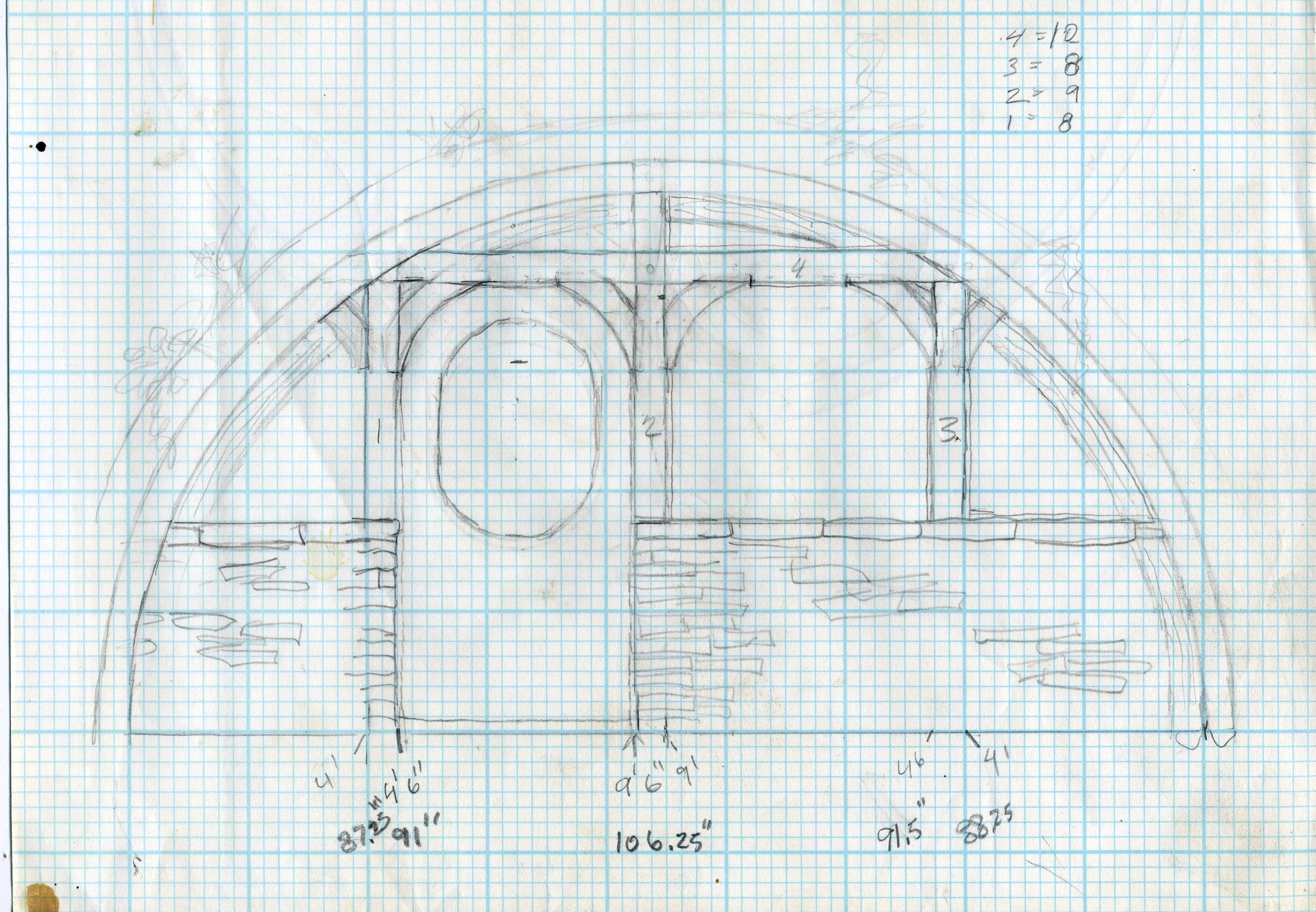
We started building our house 25 years ago. I wish I could say that it is finished, but… even the album we have been keeping is not up to date.  Since it started my kids have grown and have their own kids, the Internet and Windows took over the digital world.  There were no cell phones etc. etc.  So the plans I could find in my files were drawn on graph paper.  Before that I had a bag full of corks that I had cut in half lengthwise and several other ways.  I would piece these together to see different house configurations.  The one I ended up with was comparatively simple, except for the dome.  But more on that later.

The foundation

The foundation

Before I moved to Stevens County, I worked in an alternative energy resource center funded by a grant in the Carter administration.  We did workshops on building greenhouses, determined the best spot for solar exposure for people, installed solar arrays and such.  I guy I met there, CR Conn, a “retired” cement plant owner was excited about the potential for concrete arch construction.  He had some engineers at Washington State University do some tests.  They showed that a circular arch is 10 times stronger to a compressive load than a flat wall.  A round structure is 100 times stronger.  The WSU lab had a ton (2000 lb.) of weight resting on four egg shells.  CR’s idea was to mass produce concrete arches that could be pieced together quickly to make buildings.  The idea also solved another issue with underground buildings, they needed to shed water, so flat roofs would not work well for holding up dirt or holding out water.  I liked CR’s ideas so when I moved to Stevens County, Washington in 1984, I went looking for a place to build a house out of concrete arches.

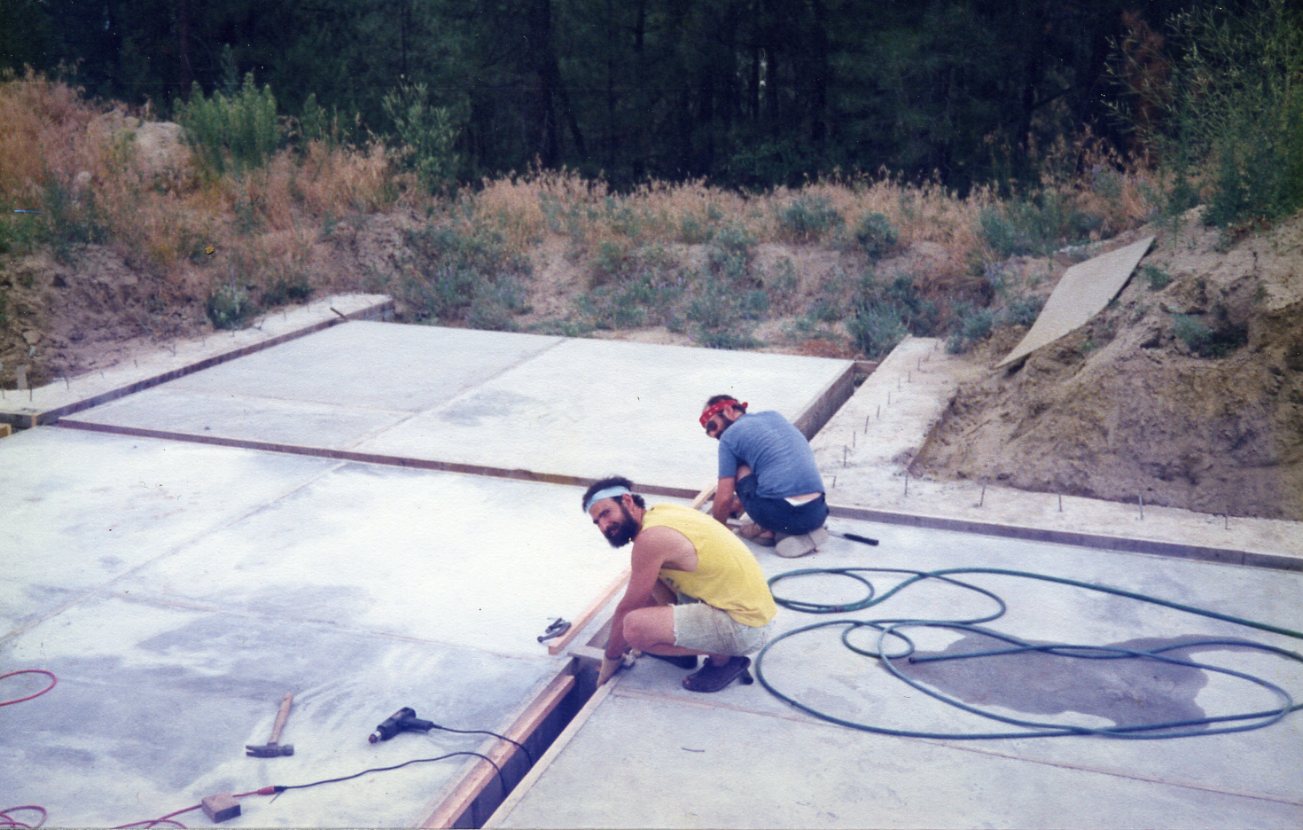
I found one that has well-drained sandy soil.  I knew that the house would try to settle and either had to be on solid rock or something evenly soft on all sides.  All the weight of the house rests on the outside edges of the foundation.  With over a million pounds of dirt plus about 200,000 pounds of concrete and steel, the footings were expected to sink an inch or more after the house was buried.  So the concrete pads for the floor were designed to “float” separated from the footings by utility gutters for the power, water, sewer, telephone, TV etc.  The picture shows my brother John and I working on them.  Having the pads done first was not ideal since they dry rapidly in full sun, but I needed a flat solid place to work since the next phase was to build forms that would in turn be used to build forms to hold the concrete.

Forms for forms

Forms for forms

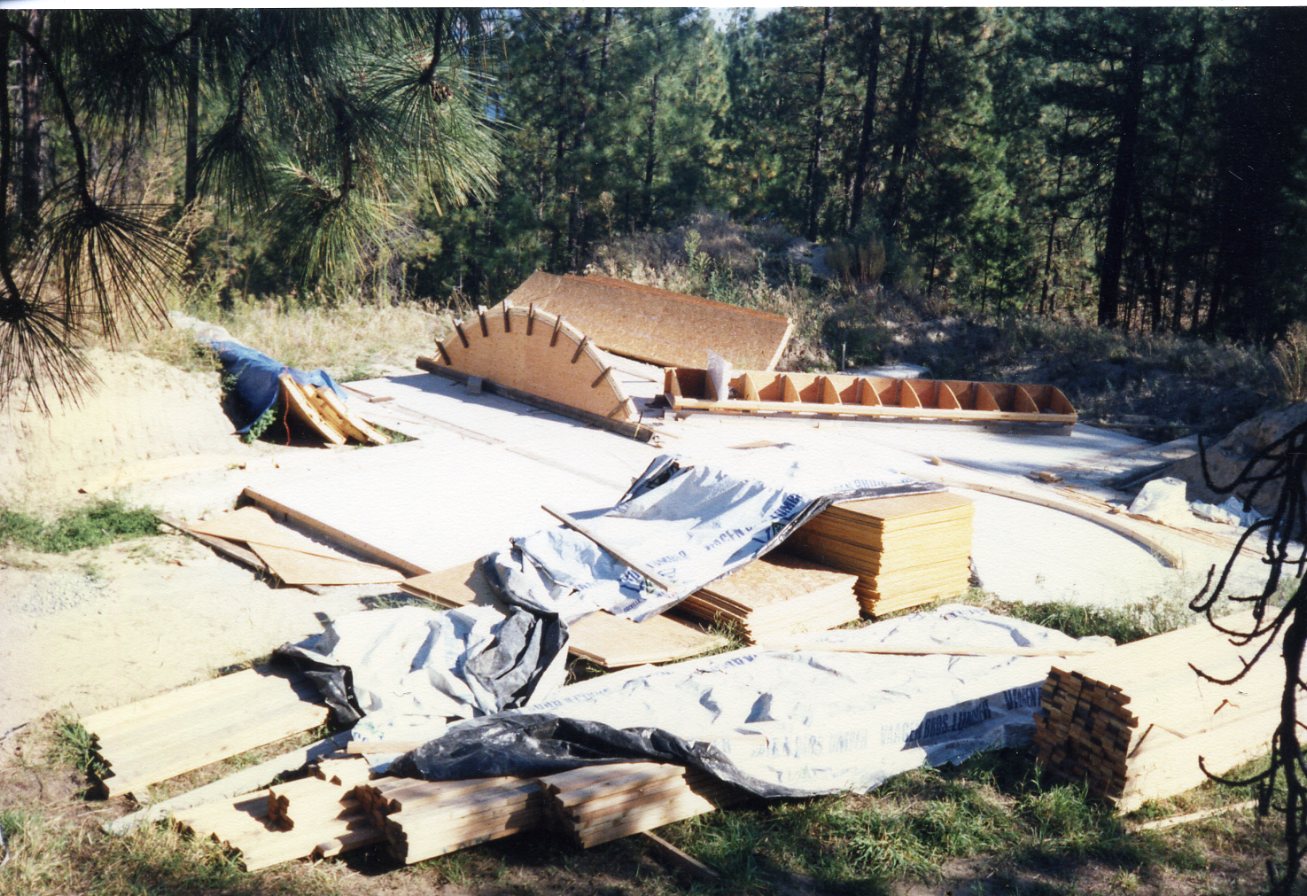
I had done some testing by building a root cellar using arch construction, so I knew that I wanted to have arches that were 18 feet across and up to 24 feet long.  In the picture you can see the stack of plywood and pressboard that I needed and the form with ribs for bending the wall panels toward the far side of the floor.  One of the panels is lying on edge behind the panel form.  In front of the panel to the left is a form I used to clamp several layers of 1×4 pine boards that were glued together to make ribs to hold up the wall panels.  The panels themselves were made with 2x4s and insulation between plywood on the outside and pressboard on the inside.  I knew that it would take several years to build the house and wanted to be able to use the space inside before it was complete.  Having insulated wall panels made that possible.  Now that they have all been removed, I used them to make outbuildings around the place for a woodshed, a shop and some storage.

Raising the arches

Raising the arches

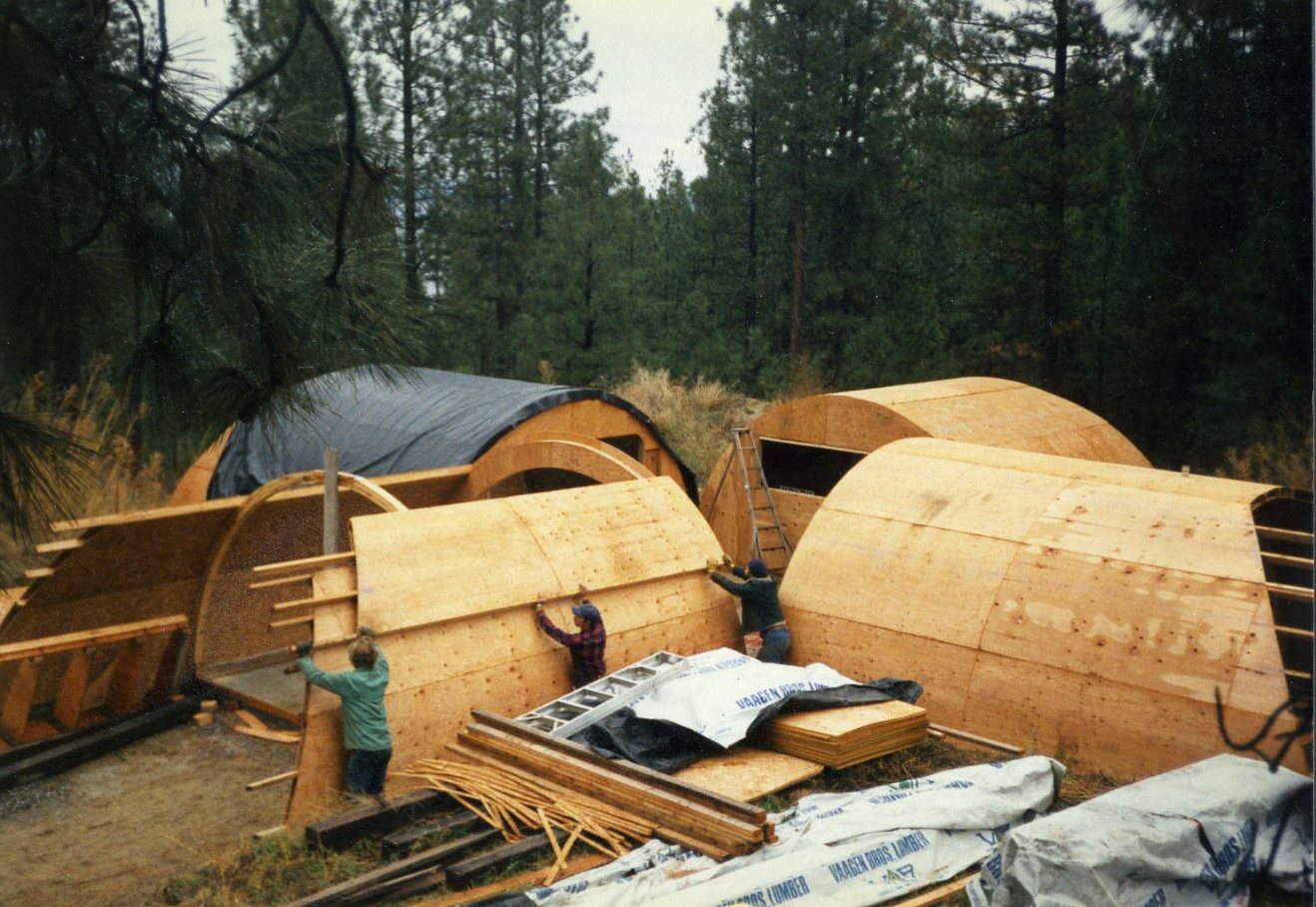
It all came together in the fall of 1990.  I had a couple of friends help me put up three of the arches in just one afternoon.  The ends of the walls were tapered to the ground so that the dirt would have some room to build up toward the roof at a slope.  (There are many of these details that I would do a little differently now, but this one basically worked.)  There were some 2×4 boards under the wall panels that were intended to be pulled out when it was time to pull the forms out in order to relieve the pressure on the keystone formation of the wall panels.  It was a huge relief to see the house take shape so suddenly after a summer of building the pieces.  In the back right you can see the window on a room that is already closed in.  That arch was to become our bedroom for many years.  Cheryl and I had moved out of the trailer where we cooked and my girls, Bina and April slept.  During this phase, we slept in a tree house from which this picture was taken.  HouseBuilding007

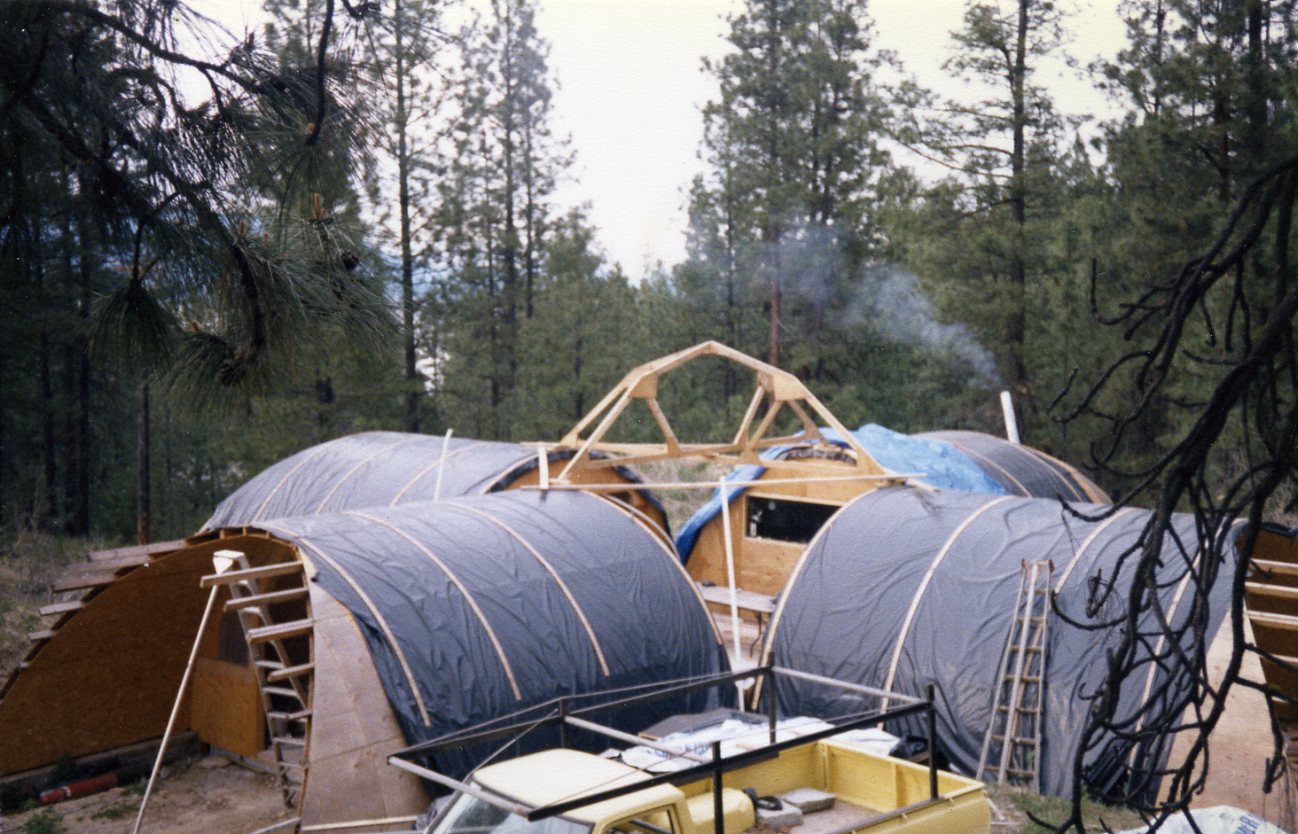
It was getting to be late in the year and I wanted to get a cover over the middle of the house.  I came up with a plan to use PVC pipe bent to make a curved surface that I covered with blue plastic tarps.  This worked pretty well for rain, but then one day we got a foot of wet snow that stuck to the tarps.  The PVC pipes were just not strong enough for that and the whole thing caved in so that the tarps were now funneling the snow into the middle of the house.  But they did not break.  I was able to put a 55 gallon barrel in the center under the tarp to hold the weight of the snow above the floor without the tarps ripping and dumping the whole mess inside.  With the barrel in place, I had my daughter Bina go to the corner between these two arches.  I got inside under the tarp and had her walk over the tarp on my back as I shuffled over to the barrel.  Once she was on the barrel, I gave her a snow shovel and she was able to shovel the snow out to the corner between the arches where I moved it away from the house.  After that I built a strong set of trusses out of wood with plywood sheathing that

Wooden Trusses

Wooden Trusses

is still holding up well as the roof of our garden shed.

In this picture you can see the smoke rising from the bedroom portion of the house.  The other rooms were a large open space where I constructed another set of forms to glue and peg together the curved laminated beams that would form a dome between the four crossvault arches.   I could try to explain how that was going to work, but pictures will work better for that. Not much outside construction was going to be done during that first winter and not much more house construction is going to be shown in this month’s blog.  It will be another 4 years before we can move into the house shown at this stage, but at least we were not sleeping out in the tree house all winter.

Springing Up and Down

As the northern latitudes pass through the equinox, we expect things to warm up and even out. The only “even” things about this Spring would have to be averages because the highs and lows were extreme. This can be said of temperatures and to some extent events. The coldest day of the year by my records was 19 Degrees on March 4th. A week later the high was 65 Degrees. We have hit that several times more and climbed into the mid 70’s today. By most accounts it was the mildest winter and the earliest Spring ever. It looks like the California drought is headed our way.

Jar focusing light

Jar focusing light

The day before that record low, the sun almost started our house on fire.  I had just (almost accidentally) fixed a problem with our Internet that had been driving me nuts for weeks by updating the router software. I was feeling great when Cheryl called from the house saying that she smelled smoke. Soon we were both walking around the house trying to figure out where the smell of burnt paper was coming from. We finally located it behind a gallon jar of water sitting on the kitchen floor. The afternoon sun was shining through the window onto the water which acted like a lens and focused the light into a small spot on a cardboard box in back of it that was smoldering. I never suspected that water could start a fire. We have kept the jug out of the sun since then.

Hole burnt into box

Hole burnt into box

At the end of that week I was holding down a booth at our rock club’s gem and mineral show. My geologic atlases were selling well and I was eager to get to the show on time. Before I could leave in the morning we heard a lot of commotion on the state highway below our house. Cheryl went down to check it out and soon called me down to take our dog away from the traffic. An old lady, who turned out to be a neighbor we had not met,

Car wreck on the highway

Car wreck on the highway, driver on rail.

had crashed her car through the end of a guard rail and over the bank. it was 8 o’clock in the morning and she was too drunk to drive! When the emergency services people arrived she was alright. She had a couple dogs with her that were eventually returned home. I was late for the show and the guard rail is still broken, but the month marched on.

March 9th seemed like a nice day. It was so warm that I had to drive with my window down for the first time all year.

Gray-C get intense

Gray-C gets intense

Both our cat and dog “helped” me while I was pruning grapes. But we later heard that an old friend from Rose Valley, Dave Brown, died in his sleep from a heart attack. His memorial pot luck last Saturday was well-attended and we were all asked to drink a shot of whiskey in memorium, perhaps because he drank a whole bottle every Saturday.

Two weeks after the Rock Show I had a booth at the Colville Home and Garden Show where I sold grape plants and gave two talks about grapes. I did pretty well selling grape plants but someone stole one of my geologic atlases from my booth while I was giving a presentation on grapes. So it was not such a big success.

I did however have several people sign up for a grape pruning workshop here

Pruning Class

Pruning Class with Colville Garden Club

the next weekend. Everyone enjoyed it and I sold grape plants, wine and map books.

April is a marathon of birthdays around here: April 1st Grandson Ovid, April 2nd friend Mary Selecky, April 3rd daughter April Barreca, April 4th grandson James Houston and April 8th sister, Jeannette Barreca; April 9th Son-in-law Joe Brock and friend Marcia Wingate. Cheryl and I went to Jame’s 2nd birthday party and missed Mary

Birthday party

Jame tries on a new hat.

Selecky’s Easter party. There were more adults than children, more food than we could eat and more activities than we could stay for. It was an over-the-top birthday party and James loved it and we did too.

Now, April is half over. The pruning is done. My taxes are paid. Some flowers and trees are blooming. Grape starts cover much of my office floor. (They love the sub-floor heating.) Mapping contracts and wine tastings are stacking up. Today was the hottest day of the year and I got our new BBQ installed. Don’t expect to see

Grape Plants ready to plant.

Grape Plants ready to plant.

another blog for a month or more. But if you want some wine grape plants, give me a call. I am ready to practically give them away.

Pear Tree in Bloom

Pear Tree in Bloom

Rules for Radicals

Alinsky

Rules for Radicals

On February 18th I received an email from my uncle about Saul Alinsky’s book. Rules for Radicals.

It said:

There are eight levels of control that must be obtained before you are able to create a social state. The first is the most important.

1) Healthcare? Control healthcare and you control the people

2) Poverty ? Increase the Poverty level as high as possible, poor people are easier to control and will not fight back if you are providing everything for them to live.

3) Debt ? Increase the debt to an unsustainable level. That way you are able to increase taxes, and this will produce more poverty.

4) Gun Control? Remove the ability to defend themselves from the Government. That way you are able to create a police state.

5) Welfare ? Take control of every aspect of their lives (Food, Housing, and Income)

6) Education ? Take control of what people read and listen to take control of what children learn in school.

7) Religion ? Remove the belief in the God from the Government and schools

8) Class Warfare ? Divide the people into the wealthy and the poor. This will cause more discontent and it will be easier to take (Tax) the wealthy with the support of the poor.

Since Alinsky died 43 years ago and many of these issues seemed very contemporary, I looked up these assertations on Snopes and found out that they were really a re-write of some anti-communist literature that had nothing to do with Saul Alinsky or his book.

Curious as to why the right wing nuts would have taken this approach to discrediting Barack Obama, I checked the book out from our local library and read it cover to cover. It turns out that Alinsky was not even really a Marxist. What he was was a very effective community organizer that scared the bejesus out of rich people. He does use stories from the bible fairly often to illustrate a point. He even has several stories about working with people in the Catholic Church. In one he was asked by some newly ordained priests how to keep their faith while trying to change the system. His response was “When you go out that door, just make your own personal decision about whether you want to be a bishop or a priest, and everything else will follow.” (Page 13)

In another he is talking to a bishop about the right to birth control. Outside the office while they are meeting are several celibate priests waiting for an audience. The bishop tells him that the Catholic Church does not condone any form of birth control. Alinsky opens the door to the waiting room, gestures to the priests and says something to the effect of “Is that so?”

Amazingly his predominant advice is not to come into any situation with a preconceived idea of what is going on or what to do about it. For instance he says “If you respect the dignity of the individual you are working with, then his desires, not yours; his values, not yours; his ways of working and fighting, not yours; his choice of leadership, not yours; his programs, not yours, are important and must be followed; except if his programs violate the high values of a free and open society.” (Page 122)

He does have some actual rules in the book in the chapter on Tactics.
1. Power is not only what you have but what the enemy things you have.
2. Never go outside the experience of your people.
3. Whenever possible, go outside the experience of the enemy.
4. Make the enemy live up to their own book of rules.
5. Ridicule is mans most potent weapon.
6. A good tactic is one that your people enjoy.
7. A tactic that drags on too long becomes a drag.
8. Keep the pressure on.
9. the threat is usually more terrifying than the thing itself.
10. The major premise for tactics is the development of operations that will maintain a constant pressure upon the opposition.
11. If you push a negative hard and deep enough, it will break through to its counterside.

He quotes Christ “He that is not with me is against me.” (Luke 11:23)(Page 139) This was an example from the story of Christ throwing the money changers out of the temple which many believe was the act that earned him the deadly attention of the Romans.

He always advised people to do things that were legal. Actually his advice could be used by any group, even a religious one that felt it was being ignored by authorities. The book has a lot of great stories about incidents in Alinsky’s life. I won’t try to repeat them all here. The real question remains as to why neo-McCarthyists picked this man and his book as a cardinal example of the great evil of progressive politics and went to the trouble to lie so extensively about it. I think there are two answers. One Alinsky was irrationally demonized in his time and an older generation remembers that sensation more than any actual facts. Secondly, it was so long ago that outright lies about him would escape casual scrutiny.

Ironically, Alinsky admits in the first chapters of this book that in order to accomplish change, you need to pick a target and exagerate the evil character of that person. If you do not, he (or she) will blame the system or some other partially responsible person who will further blame another etc. and etc. for the problems you are addressing. If you pin the problem however on just one person, others who share the responsibility for the situation will swarm to that person’t defence. By negotiating with that group, some actual changes can be accomplished.

In that light, the real target here is not Alinsky, but Obama, and in targeting Obama any liberal thinkers are painted with the same brush. Personally, I have several objections to Obama’s policies myself. I am very concerned about his allegiance to chemical companies who are poisoning us with pesticides and herbicides that other counties have banned. I think the Trans Pacific Partnership (TPP) is a formula for world domination drawn up in secret by huge corporations who strive to be outside the control of any government. All the wedge issues thrown into these lies about Alinsky are designed to prevent ordinary people from organizing themselves over real issues that will shape the world for generations to come. More than ever, we need to approach Alinsky’s book with open eyes and without preconceived ideas so that we can become organized.